

? Which approach will give you steady, long-term growth: organic traffic, paid ads, or a smart combination of both?
Organic Traffic vs Paid Ads for Sustainable Growth
You’ll read this article to decide whether organic traffic or paid ads match your growth goals, timelines, and budget. The comparison below will give you clear, actionable guidance so you can design a strategy that supports sustainable growth rather than short, unsustainable spikes.
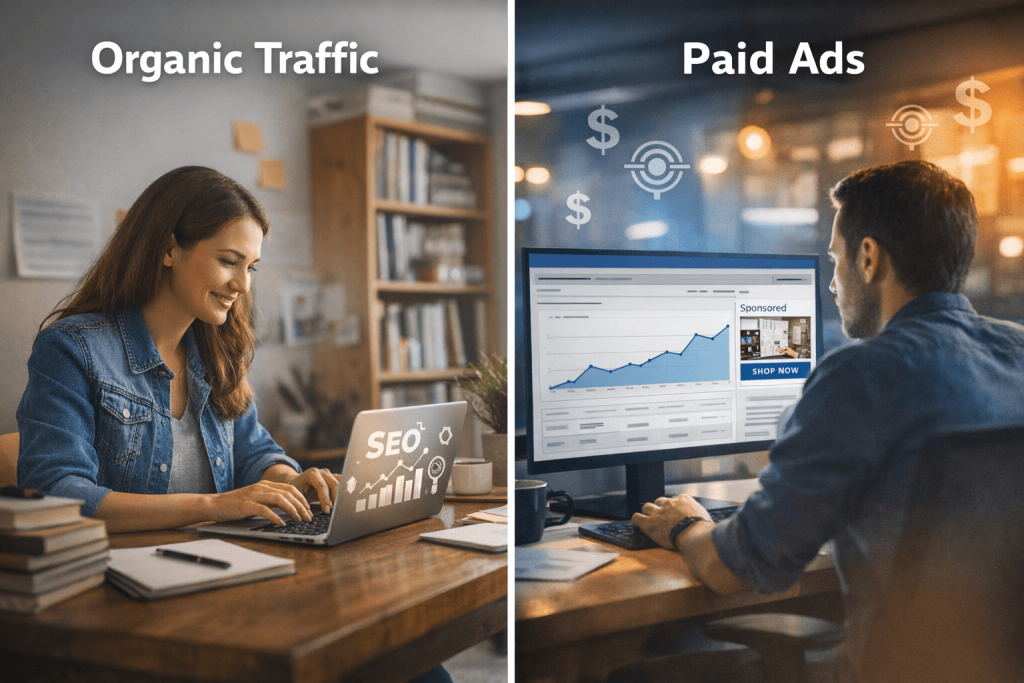
What is Organic Traffic?
Organic traffic comes from people who find your website, content, or social profile without you paying directly for that click. You’ll generate organic traffic through search engine optimization (SEO), content marketing, social engagement, referrals, and email marketing.
What are Paid Ads?
Paid ads are traffic you buy through platforms like Google Ads, Meta (Facebook/Instagram) Ads, LinkedIn Ads, and programmatic networks. You’ll use paid advertising to get immediate visibility, precise targeting, and scalable reach by bidding on placements or paying per impression/click.
Why Sustainable Growth Matters
Sustainable growth ensures your business grows predictably and profitably over time instead of relying on one-off spikes that disappear as soon as you pause spending. You’ll want growth that compounds — each month’s gains should help the next period perform better without proportionally rising costs.
Long-term vs Short-term Goals
You need to separate short-term objectives like sales peaks or new product launches from long-term aims such as brand authority and low-cost customer acquisition. You’ll select tactical mixes differently depending on whether you’re prioritizing quick scale or durable market position.
Brand Equity and Trust
Sustainable growth is closely tied to brand equity and customer trust, which build slowly through repeatable experiences and consistent content. You’ll find that organic strategies tend to support credibility, while paid can amplify trust-building content once it exists.
Key Differences: Organic vs Paid
Understanding fundamental differences will help you allocate time and budget effectively. Below is a compact comparison that highlights the most important contrasts you’ll need to consider.
| Dimension | Organic Traffic | Paid Ads |
|---|---|---|
| Cost Model | Upfront time + ongoing effort; low direct media costs | Pay-per-click / impression / conversion; ongoing media spend |
| Time to Results | Medium to long-term (months) | Immediate to short-term (hours to days) |
| Predictability | Less predictable in the short term; more stable long-term | Highly predictable while budget is active |
| Scalability | Scales slowly and with effort | Scales quickly with budget |
| Trust & Credibility | Higher long-term trust via content and rankings | Lower inherent trust; depends on ad quality |
| Targeting | Topic/intent-based via content and SEO | Precise demographic, behavioral, and intent targeting |
| Measurement | Organic attribution can be complex | Easy to measure conversions and ROAS |
| Durability of Results | Lasting (content and backlinks endure) | Stops when spend stops |
Cost and Budget Predictability
You’ll find that organic strategies require more labor and patience but have lower ongoing media costs once established. Paid ads give you budget-driven predictability: if you spend X, you can expect roughly Y in traffic and conversions, assuming stable performance.
Time to Results / Timeline
Organic channels typically take months of consistent effort before delivering reliable traffic, while paid channels deliver immediate visibility. You’ll want to map timelines: organic for long-game compounding value, paid for immediate testing, launches, or demand capture.
Targeting and Reach
Paid ads let you laser-focus on demographics, interests, behavior, and intent signals, making them great for targeted offers. Organic reaches people based on topic relevance and search intent, which often attracts higher-quality, intent-driven visitors for evergreen topics.
Scalability and Control
Paid gives you direct control over scale — increase the budget, get more impressions and clicks. Organic is more constrained by content production capacity, domain authority, and algorithmic changes. You’ll balance control and scalability against cost and sustainability.
Trust, Credibility, and User Intent
Organic placements (search results, authoritative content) often carry more trust; many users skip or distrust ads. You’ll use organic channels to earn trust over time and paid channels to quickly capture intent or retarget interested audiences.
Data and Measurement
Paid platforms give you granular, immediate performance data that’s easy to act on. Organic data often requires longer test cycles and careful attribution, but it helps you understand long-term trends in keywords, content performance, and user lifetime value.
Pros and Cons
You’ll want a clear view of strengths and weaknesses for each approach to decide where to focus resources.
| Aspect | Organic Traffic (Pros) | Organic Traffic (Cons) |
|---|---|---|
| Cost Efficiency | Low ongoing media cost once built | Upfront time and resource intensive |
| Longevity | Content and SEO compound over time | Slow to start; algorithm risk |
| Trust | Builds credibility and authority | Harder to control messaging precisely |
| Lead Quality | Often high intent and engagement | Difficult to scale rapidly |
| Aspect | Paid Ads (Pros) | Paid Ads (Cons) |
|---|---|---|
| Speed | Fast visibility and conversions | Costs scale with volume |
| Targeting | Granular audience controls | Ad fatigue and rising CPCs in competitive niches |
| Measurement | Easy conversion tracking and attribution | Reliance on third-party platforms; potential data privacy changes |
| Flexibility | Quick creative and targeting tests | Can be expensive and require continuous optimization |
How You Should Think About These Trade-offs
You’ll prioritize paid when you need immediate demand or to validate offers quickly, and organic when you want durable, compounding returns. Smart teams use both in a coordinated plan to reduce risk and maximize lifetime customer value.
When to Use Organic Traffic Strategies
Organic strategies are ideal when you’re focused on long-term authority, lower CAC over time, and content assets that continue to deliver value. You’ll invest in organic when you have a timeline of several months to a few years and want sustainable account growth.
Best for Startups and Limited Budgets
If your budget is small, organic can deliver compounding results without the financial drain of continuous ad spend. You’ll need to be patient and consistent, focusing on high-quality content and technical SEO best practices.
Best for Building Authority and SEO
Organic is the right choice when your strategy depends on thought leadership, educational content, or inbound lead generation. You’ll create content that ranks and earns backlinks, supporting long-term search visibility.
Tactics: Content, SEO, Social, Email
You’ll use a mix of long-form content, topic clusters, on-page SEO, technical fixes, social posting for reach, and email to nurture leads. These tactics work together to turn first-time visitors into repeat customers.
When to Use Paid Ads
Paid ads are best when you need immediate traffic, control, and precise targeting for promotions, launches, or testing. You’ll use paid channels when time-to-market matters more than building long-term assets.
Best for Immediate Traffic and Launch
Use paid ads to fuel product launches, flash sales, or to hit revenue targets within a specified period. You’ll see results quickly and can iterate on creatives and targeting in near real time.
Best for Competitive Markets and Testing
Paid channels let you test offers, messaging, and audiences quickly so that you can refine your organic roadmap based on real-world response. You’ll use testing data to guide SEO topic selection and content angles.
Tactics: Search Ads, Social Ads, Display, Retargeting
Search ads capture high-intent queries, social ads excel at interest-driven awareness and prospecting, display and programmatic help with wide reach, and retargeting converts visitors into customers. You’ll combine tactics based on funnel stage and conversion goals.
How to Measure Success
Your measurement approach will differ between channels, but both require rigorous KPI selection and periodic review. You’ll want to build a measurement plan that ties channel performance to business outcomes like revenue and lifetime value (LTV).
Key Metrics for Organic vs Paid
Below is a table of common KPIs you should track for each channel category. You’ll use these metrics to evaluate performance and optimize allocation.
| Channel Type | Primary KPIs | Secondary KPIs |
|---|---|---|
| Organic | Organic sessions, keyword rankings, backlinks, conversions from organic | Time on page, bounce rate, pages per session, assisted conversions |
| Paid | Click-through rate (CTR), cost per click (CPC), cost per acquisition (CPA), ROAS | Conversion rate, impression share, frequency, ad relevance score |
Choosing the Right KPIs for Sustainable Growth
You’ll focus on metrics that show durability: organic growth rate, new keywords ranking, and LTV to CAC ratio. For paid, you’ll evaluate cost efficiency and incremental revenue while also measuring how ads influence organic growth.
Attribution and Lifetime Value
Attribution models (last-click, last non-direct, data-driven) shape how you credit channels for conversions. You’ll combine accurate attribution with LTV analysis to understand true ROI — paid channels may look expensive on first touch but profitable when considering LTV.
Combining Organic and Paid for Sustainable Growth
You’ll get the best results by using paid to accelerate and test, while organic builds the durable foundation. A coordinated approach minimizes waste and strengthens compound growth over time.
Hybrid Strategies
Use paid campaigns to promote high-performing organic content and to seed initial traffic to new content assets. You’ll also retarget organic visitors with paid ads to increase conversions and shorten the path to purchase.
Budget Allocation Framework
Your budget should shift as your business matures and organic assets grow. Below is a sample allocation framework you can adapt depending on stage and goals.
| Stage | Monthly Budget Focus | Typical Allocation |
|---|---|---|
| Early (0–6 months) | Validation & visibility | 60% paid / 40% organic content and SEO |
| Growth (6–18 months) | Scaling & optimization | 50% paid / 50% organic with emphasis on content clusters |
| Maturity (18+ months) | Efficiency & retention | 30% paid / 70% organic and retention marketing |
You’ll re-evaluate allocations quarterly based on CAC, ROAS, and organic traffic trends.
Examples and Case Studies
Here are two short, realistic examples you can relate to when planning your strategy.
- SaaS Startup: You’ll use paid search to capture trial sign-ups during launch months while publishing high-value how-to content and building SEO around core features. After 12 months, organic content reduces CAC by 35% while paid drives continued acquisition for expansion.
- E-commerce Brand: You’ll run retargeting ads to convert visitors from seasonal campaigns, while long-term SEO for product categories brings steady traffic. After 9 months, organic search accounts for 50% of non-paid conversions, allowing you to reduce ad spend on broad prospecting.
Implementation Roadmap
You’ll need a practical roadmap that sequences paid tests, organic content creation, and measurement. Below is a 12-month plan you can follow or adapt.
| Month Range | Focus Areas | Key Activities |
|---|---|---|
| Months 0–3 | Setup & Validation | Set tracking, run small paid tests, audit SEO, create top 10 content pieces |
| Months 4–6 | Scale & Optimize | Scale winning paid audiences, expand content cluster, fix technical SEO issues |
| Months 7–9 | Integrate & Amplify | Promote organic content with paid, add retargeting funnels, optimize landing pages |
| Months 10–12 | Consolidate & Measure | Evaluate CAC vs LTV, shift budget toward organic wins, create retention campaigns |
You’ll iterate based on data and move budget gradually from paid to organic where you see compounding returns.
Tactical Checklist per Month
You’ll use a consistent cadence of tasks to maintain both channels: weekly ad creative tests, biweekly content publication, monthly SEO audits, and quarterly strategy reviews.
Common Mistakes to Avoid
Even with a good plan, you can make errors that slow growth. Avoid these common pitfalls to keep momentum.
Over-reliance on Paid
You’ll risk high CAC if you depend solely on paid. When market CPCs rise, campaigns become less profitable and you lose long-term resilience if organic channels are neglected.
Neglecting Technical SEO
You’ll create content but may miss the technical foundations that enable search engines to index and rank it. Technical debt reduces organic potential and can waste your content investment.
Poor Measurement and Attribution
You’ll misallocate budget if attribution is inconsistent or tracking is broken. Accurate measurement is essential to know which channels and campaigns truly drive revenue.
Quick Checklist for Your Strategy
Use this checklist to ensure you cover essential items for both organic and paid strategies.
| Item | Organic | Paid |
|---|---|---|
| Tracking implemented (analytics, goals) | Yes | Yes |
| Technical SEO audit completed | Yes | N/A |
| Content calendar (3–6 months) | Yes | N/A |
| Initial paid tests run | N/A | Yes |
| Landing pages optimized for conversion | Yes | Yes |
| Retargeting set up | Yes | Yes |
| Attribution model agreed | Yes | Yes |
| LTV/CAC target defined | Yes | Yes |
You’ll revisit this checklist monthly and update priorities based on performance.
Frequently Asked Questions
You’ll likely have practical questions about balancing both channels. Here are answers to common queries.
How much budget should I allocate to paid vs organic?
Start with the allocation framework above and adjust based on results. You’ll allocate more to paid early for validation and shift toward organic as content gains traction and CAC declines.
Can paid ads harm organic performance?
Paid ads don’t directly harm SEO, but poor landing experiences or inconsistent messaging can reduce quality signals. You’ll ensure landing pages match organic content quality to support both channels.
How long before organic traffic pays off?
Expect meaningful organic gains in 4–12 months, depending on competition and content quality. You’ll accelerate learning with paid tests that inform content strategy during this period.
Should I stop paid ads once organic grows?
You should rarely stop paid entirely; instead, reallocate paid spend to higher-margin, retention, or promotional campaigns while letting organic handle base traffic. You’ll keep paid for flexibility and quick reach when needed.
How do I measure the combined impact of organic and paid?
Use multi-touch attribution, cohort analysis, and LTV models to see how paid acquisition supports organic growth and vice versa. You’ll track assisted conversions and revenue per channel over time.
Final Recommendation
You’ll get the best chance at sustainable growth by combining organic and paid in a coordinated, data-driven manner. Use paid ads for speed and testing, and invest in organic for credibility and long-term cost efficiency. Over time, let performance and LTV metrics guide the balance so your strategy becomes more efficient and resilient.
Next Steps You Can Take This Week
You’ll make progress now by setting up measurement, running at least one small paid test, creating a simple content calendar, and fixing any major technical SEO issues. Those four moves will give you immediate insight and a foundation for compounding growth over the months ahead.
If you want, share your current monthly budget, time horizon, and primary goal (revenue, leads, awareness), and you’ll get a tailored allocation and 3-month plan you can execute immediately.