
Have you ever wondered why some potential customers move quickly from interest to purchase while others never make it past the first interaction?
What Is a Sales Funnel?
A sales funnel is a visual and strategic model that maps the journey your prospects take from first awareness of your product or service to the final purchase and beyond. You can think of it as a step-by-step pathway that identifies the actions, content, and touchpoints needed to convert strangers into loyal customers.
Why the “funnel” metaphor matters
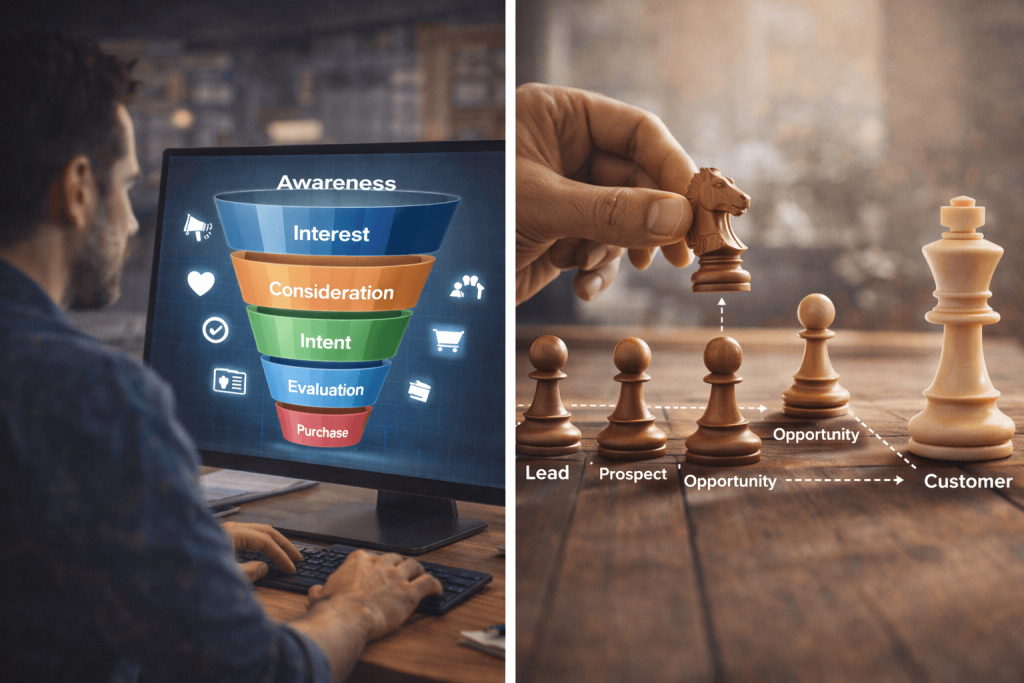
The metaphor helps you understand that many people enter the top of the funnel, but progressively fewer remain as they move toward purchase. This narrowing highlights where you need to focus your marketing and sales efforts to maintain interest and increase conversions.
The core stages of a sales funnel
Breaking the funnel into stages gives you practical checkpoints for measuring progress and optimizing performance. Each stage requires different content, messages, and metrics.
Awareness (Top of Funnel)
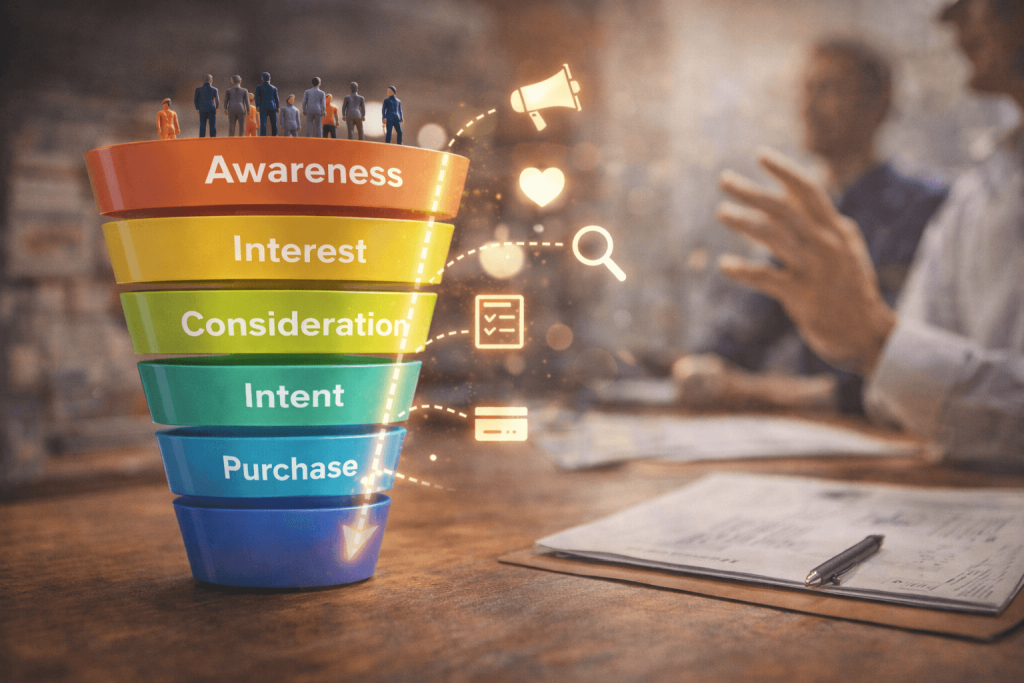
At this stage, you aim to attract broad attention and let people know your brand exists. Your goal is to generate interest through channels like social media, search, content marketing, and paid ads. Awareness is about reaching as many relevant prospects as possible.
Interest (Upper-Mid Funnel)
Once a prospect knows about you, they begin to show curiosity or engage with your content. They might read blog posts, subscribe to your newsletter, or follow you on social media. Your job is to nurture that curiosity with helpful information and build trust.
Consideration (Lower-Mid Funnel)
In the consideration stage, prospects compare solutions and evaluate whether your product or service fits their needs. You should present clear value, case studies, demos, and specifics about features and pricing that help them assess your offering.
Intent (Near Bottom)
Here, prospects indicate a strong likelihood of buying — they might add an item to a cart, request a demo, or ask about pricing. You should reduce friction and handle objections by offering guarantees, clear next steps, and persuasive proof points.
Evaluation (Bottom)
During evaluation, prospects are often deciding between final options. This is when personalized outreach, one-on-one sales conversations, and tailored proposals have the most effect. Your task is to remove remaining doubts and make the path to purchase obvious.
Purchase (Conversion)
This is the moment the prospect becomes a customer by completing a transaction. It’s essential to make the purchasing process smooth, secure, and fast. Post-purchase follow-up and onboarding begin immediately after conversion.
Retention and Advocacy (Post-Purchase)
The funnel doesn’t end with a sale. You want customers to stick around, buy again, and refer others. Use onboarding, customer success, ongoing value delivery, and referral incentives to turn customers into advocates.
Types of sales funnels and when to use them
Not all funnels are identical; different business models call for different funnel structures. Understanding which type fits your business helps you design the right content and automation.
Marketing funnel
This funnel focuses on attracting, engaging, and converting prospects primarily through content and marketing automation. You use it when inbound marketing is your primary acquisition channel.
Sales funnel
This takes a more direct, often human-driven approach — ideal for high-ticket B2B sales or complex offerings. It maps the stages of the sales process and highlights key sales activities like discovery calls and proposals.
E-commerce funnel
Designed for online product sales, this funnel prioritizes fast conversions, optimized product pages, cart recovery, and transactional marketing. It’s suitable when your transactions are mostly self-service and product-focused.
Lead generation funnel
This funnel emphasizes capturing contact information through lead magnets, gated content, and forms. It’s ideal when you need to build a list of qualified prospects for future nurturing.
Membership/subscription funnel
Used by SaaS, subscription boxes, and membership sites, this funnel focuses on trial sign-ups, onboarding sequences, and reducing churn by showing ongoing value.
Mapping a sales funnel step-by-step
You can build a practical funnel by mapping the journey from the customer’s perspective and aligning your content and offers to each stage.
Step 1: Define your ideal customer profile
Start by describing who your best customers are. Clarify demographics, firmographics, pain points, motivations, and buying behavior. This helps you target the right people at every funnel stage.
Step 2: Identify the touchpoints and channels
List where prospects will first find you and how they will progress. Map out channels like organic search, paid ads, email, social media, webinars, or sales outreach. This will show where to invest resources.
Step 3: Create stage-appropriate content and offers
Choose the best types of content for each stage — awareness pieces like blog posts and videos, consideration content like webinars and case studies, and bottom-of-funnel materials like demos, trials, and free consultations. Align your messaging to move prospects forward.
Step 4: Define conversion events and metrics
Set clear conversion events for each stage: newsletter sign-ups, content downloads, demo requests, cart additions, and purchases. Track these so you can measure funnel performance.
Step 5: Implement automation and routing
Use email sequences, CRM rules, and lead scoring to route prospects through the funnel automatically. Proper automation ensures timely follow-up and consistent nurturing.
Step 6: Test, analyze, and optimize
Run A/B tests on landing pages, subject lines, offers, and CTAs. Use analytics to find drop-off points and continuously iterate to improve conversion rates at every stage.
Important metrics to track in your funnel
To manage and optimize your funnel, measure relevant metrics that show movement and bottlenecks. These numbers tell you how effective each stage is.
Key funnel metrics
- Traffic sources and volume: Where prospects come from and how many arrive.
- Conversion rate by stage: Percentage moving from one stage to the next.
- Lead quality (lead scoring): How well a lead matches your ideal customer.
- Cost per lead (CPL): How much you spend to acquire a lead.
- Customer acquisition cost (CAC): Total cost to acquire a paying customer.
- Lifetime value (LTV): Expected revenue from a customer over time.
- Churn rate: Percentage of customers who stop using your product/subscription.
- Average deal size and sales cycle length: Revenue per sale and time to close.
Use these metrics to calculate ROI and inform budget decisions. When you know which stages underperform, you can prioritize improvements that yield the biggest gains.
Common funnel funnel-focused tools and platforms
There are many tools that help you build, track, and optimize funnels. Choose ones that integrate well with your tech stack and support key functions like landing pages, email automation, CRM, analytics, and payment processing.
Typical tool categories
- Landing page builders and form tools
- Email marketing and automation platforms
- Customer relationship management (CRM) systems
- Analytics and tracking tools
- Live chat and chatbot systems
- Payment processors and subscription platforms
- A/B testing and personalization platforms
- Webinar and meeting apps
| Function | Example tools | What they help you do |
|---|---|---|
| Landing pages | Leadpages, Unbounce, Webflow | Create optimized pages to capture leads |
| Email automation | Mailchimp, ActiveCampaign, Klaviyo | Nurture prospects with sequences and triggers |
| CRM | HubSpot, Salesforce, Pipedrive | Track leads and manage sales processes |
| Analytics | Google Analytics, Mixpanel | Measure traffic and conversions |
| Chat & bots | Intercom, Drift, ManyChat | Answer questions and qualify visitors |
| Payments | Stripe, PayPal, Shopify Payments | Process transactions and subscriptions |
| A/B testing | Optimizely, VWO | Test variations to improve conversion rates |
How to choose tools
Pick tools based on scale, budget, and integration needs. Prioritize systems that automate repetitive tasks and centralize data for clear reporting.
Content and offers by funnel stage
Each stage needs different content types and value propositions. Matching content to the prospect’s mindset improves conversion.
Top of funnel content (awareness)
This content grabs attention and provides value without asking for a purchase. Use blog posts, videos, infographics, social posts, and SEO content to attract relevant traffic. Offer general resources and address broad pain points.
Middle of funnel content (consideration)
Here, provide deeper educational content that helps prospects evaluate options. Offer webinars, e-books, comparison guides, use cases, and email courses. Encourage sign-ups and further engagement rather than immediate purchase.
Bottom of funnel content (decision)
This content helps prospects finalize purchases. Provide demos, free trials, consultations, case studies, pricing pages, and ROI calculators. Make it easy to say “yes” by addressing remaining objections.
Post-purchase content (retention & advocacy)
After purchase, send onboarding guides, training, tips, and community invitations. Encourage reviews, referrals, and upsells to grow customer lifetime value.
Lead scoring and qualification
Lead scoring is a practical technique you can use to prioritize leads and automate next steps. Assign points based on behavior (downloads, page views), firmographics (company size, title), and engagement level.
How lead scoring helps you
Scoring helps you know when a lead is ready for sales outreach versus further nurturing. It improves efficiency by focusing sales time on the best opportunities and prevents annoying prospects with untimely calls.
Example lead scoring model
- +10 for demo request
- +5 for case study download
- +3 for visiting pricing page
- +2 for opening emails
- -5 for unsubscribing
Once a lead reaches a threshold (for example, 25 points), route them to sales for a personalized follow-up.
Common funnels and sample workflows
Seeing examples helps you translate theory into practical workflows for your business.
E-commerce sample funnel
- Awareness: Social ad or organic search leads to a product landing page.
- Interest: Visitor reads product description and reviews.
- Consideration: Visitor views related items, wishlist, or signs up for 10% off.
- Intent: Visitor adds product to cart but abandons.
- Conversion: Cart abandonment email recovers the purchase.
- Retention: Post-purchase email encourages reviews and offers a discount on next purchase.
B2B SaaS sample funnel
- Awareness: Blog post about a pain point drives traffic.
- Interest: Lead downloads an e-book and signs up for email.
- Consideration: Lead attends a webinar and watches a product video.
- Intent: Lead requests a trial or demo.
- Conversion: Sales team offers tailored demo and closes deal.
- Retention: Onboarding sequence and customer success check-ins reduce churn.
Testing and optimization strategies
You must continuously test elements of your funnel to improve performance. Testing reveals what your audience prefers and where friction occurs.
A/B testing best practices
Test one variable at a time (headlines, CTAs, images, pricing layout) and run tests long enough to achieve statistical significance. Use clear hypotheses and measure impact on conversion rates and revenue.
Conversion rate optimization (CRO) tactics
- Simplify forms and remove unnecessary fields.
- Improve page load speed and mobile responsiveness.
- Use clear CTAs and directional cues.
- Add social proof and persuasive copy.
- Reduce friction during checkout by offering guest checkout and multiple payment options.
Heatmaps and user recordings
Use tools like Hotjar or FullStory to see how users interact with pages. These tools reveal scrolling behavior, clicks, and areas of confusion that analytics can’t show directly.
How to handle funnel friction and drop-offs
Identify where prospects are abandoning the funnel and test targeted solutions. Small changes can have large effects.
Common friction points and remedies
- High bounce on landing page: Improve headline relevance, speed, and clarity.
- Low form completions: Reduce fields, use progressive profiling, and highlight privacy.
- Cart abandonment: Use recovery emails, exit-intent offers, and clearer shipping info.
- Stalled demos/trials: Send reminders, provide onboarding content, and offer live assistance.
Aligning marketing and sales around the funnel
Alignment between marketing and sales ensures consistent messaging and better lead handoffs. You should set shared KPIs and a clear SLA (service level agreement) for lead follow-up.
What alignment requires
- Agreed definitions of lead stages and what qualifies as a sales-ready lead.
- Shared dashboards and reporting.
- Regular communication to refine messaging and improve conversion rates.
- Feedback loops where sales reports issues back to marketing for content fixes.
Measuring ROI and the lifetime value of the funnel
You should calculate how much revenue your funnel generates versus how much you spend acquiring that revenue. Two core metrics help here: CAC (customer acquisition cost) and LTV (lifetime value).
Simple ROI calculation
ROI = (Revenue from acquired customers – Cost of acquisition) / Cost of acquisition
Use cohort analysis to see how customers acquired in a specific period behave over time. This helps you understand long-term payback and justify acquiring customers at different prices.
Automation workflows and sample sequences
Automation makes your funnel efficient and consistent. You’ll set sequences for common actions like welcoming new subscribers, recovering carts, or nurturing trial users.
Sample email sequences
- Welcome sequence: 3–5 emails introducing your brand, showing benefits, and offering a small action.
- Nurture sequence: Educational content that builds authority and trust over time.
- Cart abandonment sequence: Reminders at 1 hour, 24 hours, and 72 hours, possibly including a small incentive.
- Trial onboarding: Daily messages in the first week to help the user experience core value.
Common mistakes to avoid
Even experienced teams fall into common traps. Avoid these pitfalls to keep your funnel productive.
Frequent errors
- Ignoring the top of the funnel and relying only on ads or paid channels.
- Failing to measure and track stage-specific conversions.
- Overcomplicating forms and checkout processes.
- Treating all leads the same without segmentation or scoring.
- Letting sales and marketing operate in silos.
Case studies and real-world examples
Understanding how other companies structured their funnels can spark ideas you can apply to your own business.
Example 1: SaaS company improves trial-to-paid conversion
A SaaS vendor used personalized onboarding emails and in-app guidance to increase trial conversion by 35%. They measured milestones like feature use and triggered outreach when prospects reached high-value actions.
Example 2: E-commerce brand reduces cart abandonment
An online retailer implemented a 3-step abandonment email sequence and improved checkout clarity, reducing cart abandonment by 22% and recovering significant revenue.
Checklist: Launching your first funnel
A practical checklist helps you launch and manage a funnel without missing critical steps.
- Define your target customer and value proposition.
- Map stages and conversion events.
- Create content and offers for each stage.
- Set up tracking and analytics.
- Implement lead scoring and automation.
- Launch landing pages and ad campaigns.
- Monitor metrics and run A/B tests.
- Optimize based on data and feedback.
Frequently asked questions (FAQ)
Answering common questions can clarify confusion and speed up implementation.
How long does it take to build a funnel?
Timeline depends on complexity. A simple lead-generation funnel can be live in days, while a full-integrated B2B funnel with automation and CRM integration might take weeks to months.
How much should I spend on customer acquisition?
Budgets vary by industry and LTV. Start by calculating how much you can afford to spend relative to expected lifetime value, then test and scale with data-driven decisions.
Can a funnel be fully automated?
Many parts can be automated, but high-ticket or complex sales often need human interaction at critical stages. Use automation to handle repetitive tasks and enable timely handoffs to salespeople.
What’s a good conversion rate?
Benchmarks differ by industry and stage. A typical top-of-funnel conversion may be 1–5%, while landing page conversions often range from 10–20% for targeted campaigns. Focus on improving relative performance over time.
Final tips for maintaining a high-performing funnel
Consistency, measurement, and customer empathy are your best allies. Keep iterating, listen to user feedback, and ensure your funnel always reflects what customers really need.
Keep the customer front and center
Understand their goals, pains, and decision process. When you design your funnel around their journey, every stage becomes more effective.
Invest in testing and analytics
Small improvements compound into large gains. Make testing part of your regular workflow and measure impact in revenue terms.
Align teams and automate intelligently
Make sure marketing and sales share the same playbook and use automation to increase responsiveness and personalization.
Conclusion
A sales funnel is more than a marketing diagram — it’s a practical framework you can use to guide prospects from initial awareness to loyal customer. By mapping stages, creating stage-appropriate content, implementing automation, and continuously testing, you’ll reduce friction, increase conversions, and grow sustainable revenue. Start small, measure everything, and iterate based on data so your funnel becomes a reliable engine for predictable growth.