
Are you ready to use AI to scale content on your affiliate marketing website and turn consistent effort into measurable growth?
AI Strategies to Scale Content on Affiliate Marketing Websites
This article lays out practical AI strategies you can use to scale content on your affiliate marketing site. You’ll get step-by-step tactics, recommended tools, workflow templates, KPIs to track, and ethical considerations so you can implement AI without sacrificing quality or credibility.
Why AI Matters for Affiliate Content
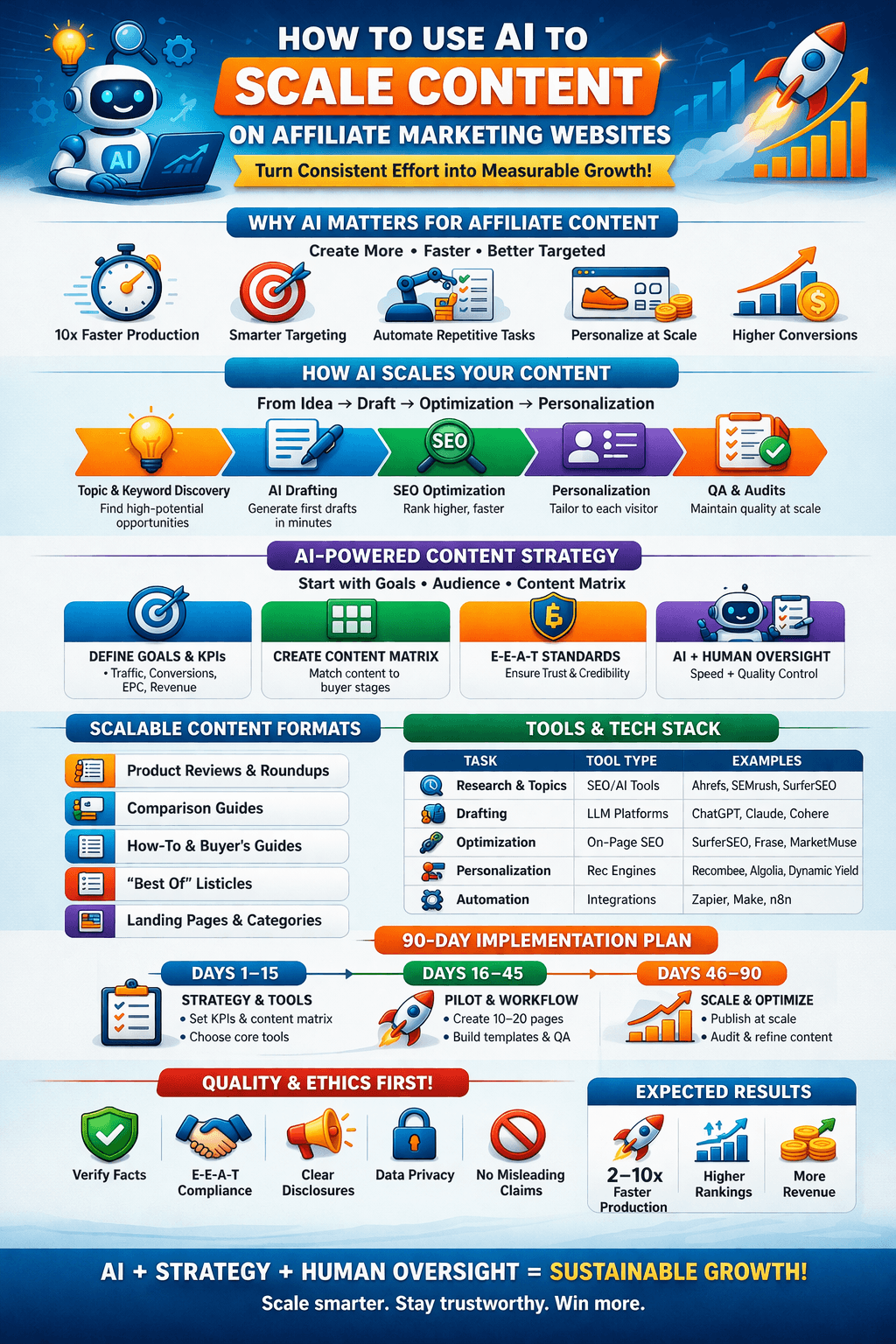
AI helps you create more content, faster, and with better targeting. It reduces repetitive tasks, accelerates research, and helps personalize content at scale so your site can attract and convert more visitors without linear increases in effort.
How AI Helps Scale Content for Affiliate Marketing Websites
AI accelerates idea generation, keyword research, content drafting, optimization, and personalization. You’ll be able to produce consistent, high-quality articles, product reviews, and landing pages while focusing your human effort on strategy and final quality control.
Faster Topic and Keyword Discovery
AI can analyze search trends, competitor content, and buyer intent to surface opportunities you might miss. This helps you prioritize content that has realistic traffic and conversion potential.
Automated Drafting and Content Generation
You can use AI to generate first drafts, product descriptions, and comparison tables, freeing you to edit and optimize rather than write from scratch. This shortens content cycles significantly.
SEO and On-Page Optimization
AI tools can suggest headings, internal links, metadata, schema markup, and content structure optimized for search engines. You’ll improve rankings by consistently applying on-page best practices.
Personalization and Dynamic Content
AI can tailor content to user segments, intent, or referral source in real time. You’ll increase engagement and conversion rates by delivering more relevant product recommendations and calls to action.
Scalable QA and Content Audits
AI can run content audits, detect duplicate or low-quality pages, and propose updates. This helps you maintain site health as volume grows.
Building an AI-Enabled Content Strategy
Your AI strategy should start with goals, audience, and a content matrix. Use AI to augment the parts of content production that are repeatable and data-driven, while maintaining human oversight for editorial voice and accuracy.
Define Goals and KPIs
Decide which metrics matter most to your affiliate business: organic traffic, conversion rate, average order value (AOV), earnings per click (EPC), or revenue per visitor. AI can help achieve these targets but you need clear goals to guide it.
Create a Content Matrix
Map content types (reviews, comparison guides, long-form articles, category pages, product pages, and email sequences) to buyer stages and search intent. AI can be assigned different responsibilities per content type.
Set Quality and E-E-A-T Standards
You must protect Expertise, Experience, Authoritativeness, and Trustworthiness (E-E-A-T). Use AI to draft, but verify facts, test claims, and include author credentials. This preserves trust with search engines and users.
AI-Powered Topic Research and Keyword Strategy
Use AI to find unmet needs, long-tail opportunities, and content gaps. The following tactics will expand your content pipeline with high-probability targets.
Use AI for Topic Clustering
Feed competitor URLs, seed keywords, and product catalogs into an AI tool to produce topic clusters. Clusters group related keywords into content hubs and supporting articles that strengthen topical authority.
Generate Long-Tail and Question-Based Keywords
AI can produce question-based keywords and conversational phrases that match voice search and featured snippet opportunities. Target these with FAQs, structured lists, and concise answers.
Prioritize by Business Impact
Combine AI keyword volume estimates with monetization potential to prioritize content. For example, a medium-volume keyword with high CPC and clear transactional intent may outrank a high-volume informational keyword in value.
Creating Content at Scale: Drafting, Editing, and Optimization
AI can handle the heavy lifting of first drafts and technical SEO, and your human team can focus on nuance, credibility, and persuasion.
Use Templates and Prompts for Fast Drafting
Create robust prompts and templates tailored to each content type (e.g., product review, comparison, how-to). This ensures consistent structure and faster output.
Example content template components:
- Title and meta description options
- Intro with user intent framing
- Pros/cons and verdict section
- Comparison table
- How to buy guide and CTA
Implement a Two-Stage Human+AI Workflow
- AI generates draft and suggested metadata.
- Human editor verifies facts, adds experience-based insights, and ensures tone and E-E-A-T compliance.
This model preserves speed without sacrificing quality.
Use AI for On-Page SEO and Schema
Have AI suggest H2/H3 structure, keyword density, internal links, alt text, and schema JSON-LD snippets for product, review, and FAQ markup. It removes repetitive optimization tasks.
Content Personalization and Recommendation
AI helps you match products and content to user intent, increasing conversion rates. Implement personalized content blocks, dynamic recommendations, and audience segmentation.
Segment Users and Personalize Experience
Use behavioral and contextual signals (geo, device, referral source, past clicks) to serve tailored content. For example, show budget-friendly product picks to users from certain referral sources.
AI-Powered Recommendation Engines
Recommendation models can suggest complementary products, alternatives, and bundles. These suggestions boost AOV while making content more useful.
Personalized CTAs and Offers
Modify CTAs based on user history and intent signals. An AI can serve a “best value” CTA for comparison shoppers versus a “buy now” CTA for users with high purchase intent.
Automation and Workflow Orchestration
Automate repetitive content operations—publishing, image processing, metadata updates, and scheduling—to maintain a high cadence without manual overhead.
Workflow Examples
- Content calendar automation: AI suggests topics, assigns writers, and schedules publishing based on predicted traffic peaks.
- Auto-tagging and categorization: AI labels content for easy filtering and taxonomy consistency.
- Bulk updates and refreshes: AI identifies outdated content and proposes batch updates.
Use APIs and Integrations
Connect AI tools to your CMS, analytics, and publishing tools to automate end-to-end content tasks. This reduces friction and ensures consistency.
Tools and Tech Stack Recommendations
Choosing tools depends on budget, scale, and specialization. Below is a comparative table to help you evaluate common tool categories and examples.
| Task | Tool Type | Examples | Why You’d Use It |
|---|---|---|---|
| Research & Topic Discovery | SEO/AI Research | Ahrefs, SEMrush, SurferSEO, Clearscope, MarketMuse | Find keywords, analyze competitors, and cluster topics |
| Drafting & Copy Generation | LLM Platforms | OpenAI, Anthropic, Cohere, Claude | Generate drafts, outlines, and product copy |
| Optimization & On-Page SEO | Optimization AI | SurferSEO, Frase, Page Optimizer Pro | Optimize headings, density, and content structure |
| Personalization & Recs | Recommendation Engines | Recombee, Algolia Recommend, Dynamic Yield | Serve tailored product/content suggestions |
| Workflow Automation | Integration Tools | Zapier, Make, n8n, custom APIs | Connect AI outputs to CMS and publishing workflow |
| QA & Content Audits | Site Auditing Tools | Screaming Frog, ContentKing, Botify | Monitor site health and identify content issues |
| Analytics & Attribution | Analytics | Google Analytics 4, Heap, Mixpanel | Track performance and user behavior |
Choose tools that fit your scale and integrate well with your CMS and analytics stack. You don’t need every tool at once—start with problem-focused choices.
Content Formats to Scale with AI
Different formats require different levels of AI involvement. Here are formats that scale well and how you can use AI for each.
Product Reviews and Roundups
AI can draft structured reviews with pros/cons and scoring frameworks. You should verify product specs, add hands-on experience, and include affiliate disclosures.
Comparison Guides
AI can generate side-by-side comparisons and summary verdicts. Use tables and scoring to help readers decide quickly.
How-To and Buyer’s Guides
AI drafts can cover step-by-step instructions and use cases. You should enhance these with real-world examples, images, and purchase advice.
Listicles and “Best of” Posts
These scale easily because the structure is repetitive. Use AI for initial lists and summaries, and human editors for curation and accuracy.
Landing Pages and Category Descriptions
AI can generate SEO-optimized category pages that improve crawlability and internal linking. Ensure the content matches actual inventory and buyer intent.
Quality Assurance: Maintaining Trust and E-E-A-T
AI can generate content quickly, but you must avoid errors, hallucinations, and unverified claims. Implement quality controls to protect reputation and SEO.
Fact-Checking and Source Attribution
Always verify facts, specifications, and price claims against primary sources. Include source links where relevant and add author bios with credentials.
Editorial Guidelines and Style Guide
Create a content style guide that defines tone, formatting, disclosure rules, and quality thresholds. Use it to train both editors and AI prompts.
Human Review and Final Approval
Assign experienced editors to approve AI drafts before publishing. Use checklists that include accuracy, affiliate disclosure, readability, and SEO checks.
Measuring Performance and Optimization
Track metrics that show whether AI-generated content meets business goals. Continuous measurement guides iterative improvements.
Key Metrics to Track
- Organic traffic (sessions, users)
- Keyword ranking improvements
- Conversion rate (clicks to affiliate links)
- EPC and revenue per thousand sessions
- Bounce rate and time on page
- Number of pages updated and lift after refresh
A/B Testing and Experiments
Run A/B tests on AI-generated headlines, CTAs, and recommendation blocks to optimize conversions. Keep experiments small and measurable.
Content Funnel KPIs
Map content performance to stages: awareness (traffic), consideration (engagement), and conversion (affiliate clicks/purchases). Use AI to tune content for each stage.
Monetization and Affiliate Optimization
AI can help optimize product selection, price messaging, and funnel nudges to increase affiliate revenue.
Optimize Product Selection
Use AI to analyze historical affiliate performance and suggest top-converting products per audience segment. Prioritize high-EPC items in your content mix when appropriate.
Use Dynamic Affiliate Links and Testing
Rotate affiliate links or offers by user segment and measure performance. AI systems can automatically choose the highest expected-value offer for each visitor.
Improve CTAs and Offer Presentation
AI can suggest CTA copy variations and placement strategies to increase clicks. Test variations systematically.
Link Building and Authority Growth with AI
AI supports research and outreach but doesn’t replace relationship-building. Use it to scale prep and personalization.
Prospect Research and Personalization
AI tools can find relevant sites, produce outreach templates, and personalize messages at scale. You should still personalize at a human level where relationships matter.
Content for Link Magnets
Use AI to help create data-driven assets, unique studies, or comparison tools that naturally attract backlinks. Ensure the data quality and methodology are robust.
Outreach Automation
Automate follow-ups and tracking, but keep manual outreach for high-value prospects. High-volume outreach benefits from AI-written drafts, which you personalize before sending.
Ethical and Compliance Considerations
Affiliate content must be transparent and honest. AI should not be used to mislead users or publish inaccurate claims.
Disclosures and Transparency
Always include clear affiliate disclosures on pages with links. This preserves trust and complies with many jurisdictions and platforms.
Avoiding Misleading Claims
Do not publish inaccurate price, availability, or efficacy claims. Have processes to verify time-sensitive information.
Data Privacy
If you personalize experiences using user data, ensure compliance with GDPR, CCPA, and other privacy laws. Use consent mechanisms and minimize data collection.
Common Pitfalls and How to Avoid Them
Scaling content with AI can go wrong if you lack controls. Here are common issues and corrective actions.
Pitfall: Publishing Unverified AI Content
Action: Enforce mandatory human verification and create a checklist that content must pass before publishing.
Pitfall: Over-Reliance on One Tool
Action: Use a diverse toolset and validate outputs with cross-checks (e.g., multiple AI responses and manual sources).
Pitfall: Quality Dilution
Action: Maintain a consistent editorial calendar with quality thresholds and periodic audits to remove or update poor-performing pages.
Pitfall: SEO Penalties from Low-Value Pages
Action: Use AI audits to find thin content and either improve, consolidate, or remove it. Focus on topic depth and user value.
Implementation Roadmap: 90-Day Plan
This phased plan helps you implement AI systematically without disrupting existing operations.
Days 1–15: Strategy and Tool Selection
- Define KPIs and content matrix.
- Choose 2–3 core tools (research, LLM, optimization).
- Create editorial and AI usage guidelines.
Days 16–45: Pilot and Workflow Development
- Run pilot projects for 10–20 pages.
- Establish prompt templates and QA checklists.
- Integrate tools with CMS for basic automation.
Days 46–75: Scale and Automate
- Expand to 50–100 pages per month depending on bandwidth.
- Automate publishing steps and scheduling.
- Start A/B tests for CTAs and recommendations.
Days 76–90: Audit and Optimize
- Run a site audit and update or remove underperforming content.
- Review KPIs and adjust priorities.
- Document lessons and refine workflows.
Example Prompts and Templates
Using consistent prompts improves AI output quality. Here are examples you can adapt.
- Product Review Prompt: “Write a 1,200-word product review for [product]. Include key specs, 5 pros/cons, target user, comparison to top alternatives, and final recommendation. Use a neutral but persuasive tone and include affiliate disclosure.”
- Comparison Guide Prompt: “Create a 1,000-word comparison between [product A] and [product B], include a comparison table, buying criteria, and a clear recommendation for different user types.”
Always append: “Include sources and verify all specs before publishing.”
Team Roles and Responsibility Matrix
Scaling requires clear ownership. Here’s a simple RACI-style breakdown.
| Role | Responsibilities |
|---|---|
| Content Strategist | Topic prioritization, KPI ownership, performance review |
| AI Prompt Engineer | Create and maintain prompts, templates, and tool configs |
| Writer/Editor | Verify, enhance, and finalize AI drafts; apply E-E-A-T |
| SEO Specialist | On-page optimization, schema, keyword mapping |
| Developer/Integrator | Tool integrations, automation scripts, CMS connectors |
| Data Analyst | Track KPIs, run experiments, provide insights |
Assign responsibilities so every AI output has a clear human owner.
Realistic Expectations and ROI
AI accelerates production and reduces per-piece cost, but it doesn’t guarantee traffic or conversions by itself. Expect:
- Faster content throughput (2–10x drafts per writer depending on workflow)
- Improved optimization consistency
- Need for ongoing editorial oversight to protect rankings and revenue
Calculate ROI by tracking content production cost per page vs. revenue per page over 3–6 months.
Final Checklist Before Publishing AI-Generated Content
Use this checklist to ensure quality and compliance:
- Is factual information verified against primary sources?
- Is affiliate disclosure clearly visible?
- Does page meet E-E-A-T standards with author attribution?
- Are schema and meta tags present and accurate?
- Has internal linking been applied correctly?
- Is the content free from hallucinations or misleading claims?
Conclusion and Next Steps
You can scale your affiliate content using AI by combining strong strategy, careful prompt design, and strict human oversight. Start with a small pilot, measure performance, and expand systems that clearly add value. Focus on preserving user trust and E-E-A-T while automating repetitive tasks. Over time, you’ll be able to grow traffic and revenue more predictably without sacrificing quality.
If you’d like, I can:
- Help draft prompt templates for your most common content types
- Create a 30/60/90-day implementation checklist tailored to your site
- Review a sample AI-generated draft and provide an editor’s checklist
Which next step would you like to take?