
Have you ever wondered how AI can make your marketing run itself while still feeling personal and strategic?
How AI Helps Build Automated Marketing Systems
This article walks you through how AI transforms marketing automation so your campaigns become smarter, more efficient, and better at converting. You’ll get practical insights, component breakdowns, implementation steps, tools, and best practices to help you plan or improve your own AI-driven marketing system.
What is an automated marketing system?
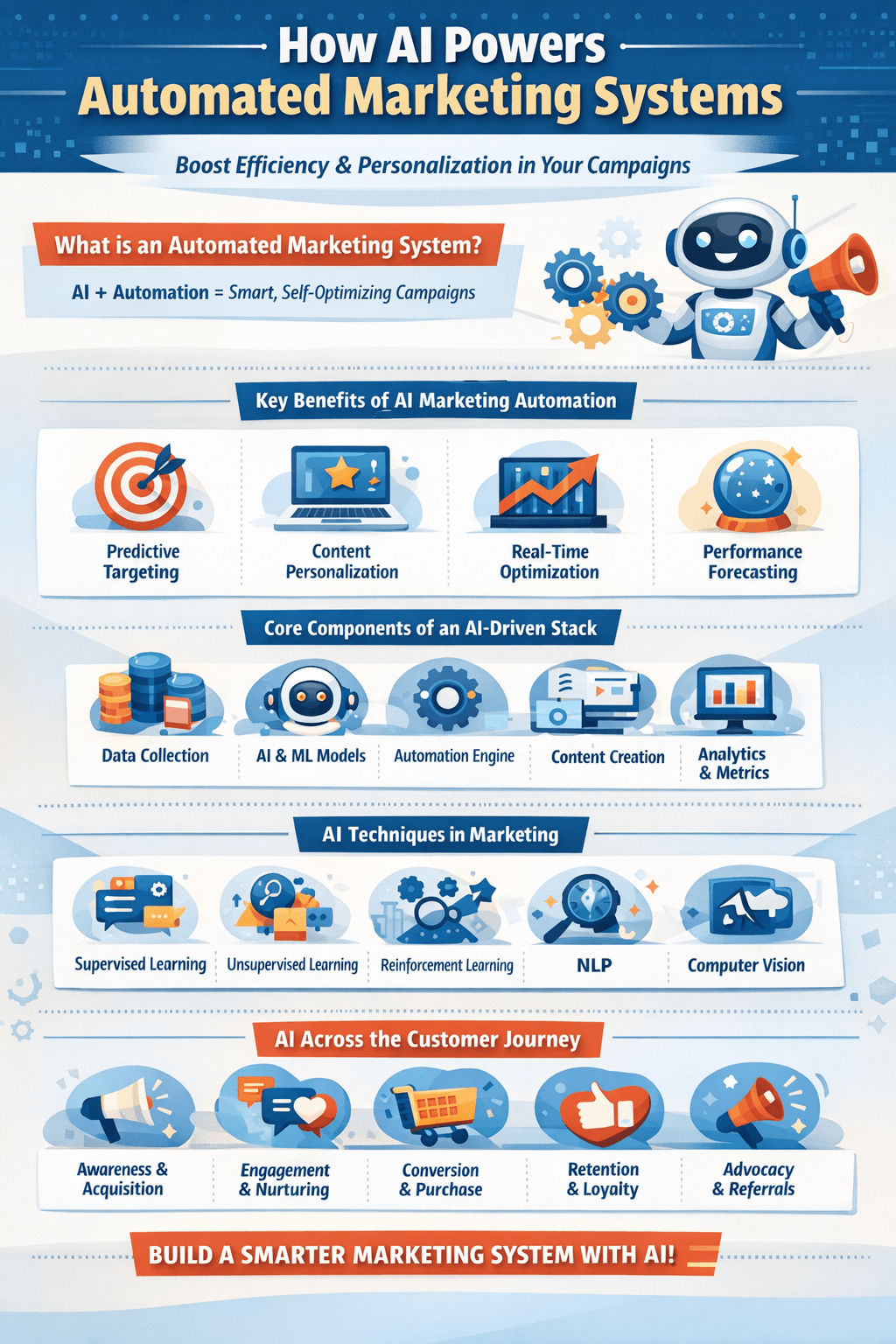
An automated marketing system uses software and integrations to run marketing tasks with minimal manual intervention. When you add AI to that system, it learns from data, predicts outcomes, personalizes interactions, and continuously optimizes actions.
Why combine AI with marketing automation?
Combining AI with marketing automation lets you scale personalization, improve targeting, and reduce repetitive work while making decisions faster and more data-driven. You’ll benefit from higher engagement, better conversion rates, and more efficient use of your marketing budget.
Key benefits of AI-powered marketing automation
AI brings speed, scale, and intelligence to automation so you can deliver the right message to the right person at the right time. These benefits include predictive targeting, automated content personalization, real-time optimization, and accurate performance forecasting.
Core components of an AI-driven marketing stack
Every AI-driven marketing system contains several core components that work together to collect data, decide, act, and measure. You’ll want to design or audit your stack around these pieces.
Data collection and storage
This is where you gather customer behavior, transactions, CRM entries, and third-party data. You’ll need consistent, clean sources and storage like a data warehouse or customer data platform (CDP).
Data processing and feature engineering
After collecting data, you clean, transform, and create features that machine learning models can use. You’ll want automated pipelines to keep features updated and accurate.
Machine learning and AI models
These models predict outcomes, segment users, personalize content, and automate decisions. You’ll choose different model types depending on use cases like classification, regression, clustering, or sequence prediction.
Decision orchestration and automation engines
This layer executes the decisions—sending emails, triggering ads, updating CRM records, or routing leads. You’ll need an orchestration engine that connects AI outputs to actions across channels.
Content generation and personalization modules
AI can create and adapt content at scale—dynamic templates, subject lines, product recommendations, and landing pages. You’ll aim for tools that integrate seamlessly with your orchestration engine.
Measurement and analytics
You’ll continuously monitor KPIs, attribution, and model performance to ensure the system is achieving goals. This requires dashboards, experiment tracking, and automated alerts.
Table: Component responsibilities
| Component | What it does for you |
|---|---|
| Data collection & storage | Captures touchpoints, transactions, and customer info |
| Data processing & feature engineering | Cleans, enriches, and prepares inputs for models |
| Machine learning & AI models | Predicts behavior, segments audiences, and personalizes |
| Orchestration & automation engine | Executes campaigns and enacts AI decisions |
| Content generation modules | Produces and customizes copy, visuals, and product feeds |
| Measurement & analytics | Tracks ROI, model drift, and campaign effectiveness |
Common AI techniques used in marketing automation
Different AI techniques are suited to specific marketing tasks, and mixing them gives you flexibility. You’ll choose from supervised learning, unsupervised learning, reinforcement learning, natural language processing, and computer vision.
Supervised learning
Supervised models are trained on labeled data to predict outcomes like churn, conversion, or click probability. You’ll use these for lead scoring, churn prediction, and propensity modeling.
Unsupervised learning
Unsupervised techniques identify structure in unlabeled data, useful for clustering customers and discovering segments. You’ll use clustering for audience discovery and anomaly detection for suspicious patterns.
Reinforcement learning
Reinforcement learning optimizes sequential decisions by learning from rewards and penalties. You’ll apply it for real-time bidding, ad placement optimization, and dynamic content sequencing.
Natural language processing (NLP)
NLP interprets and generates human language, enabling chatbots, sentiment analysis, and automated copywriting. You’ll use NLP to scale conversational experiences and create tailored messaging.
Computer vision
Computer vision analyzes images and video to identify products, logos, or user-generated content quality. You’ll use it for visual product recommendations and moderating content at scale.
How AI improves each stage of the customer journey
AI can enhance every stage—from awareness and acquisition to retention and advocacy—by predicting behavior and personalizing interactions. You’ll want to map AI capabilities to specific journey stages for targeted gains.
Awareness and acquisition
AI improves targeting, ad optimization, and lookalike modeling so you reach high-value prospects efficiently. You’ll reduce wasted ad spend and increase qualified traffic by letting AI learn which audiences convert.
Engagement and nurturing
AI personalizes messaging, sequences, and timing to keep prospects engaged across channels. You’ll use predictive timing and content selection to nudge prospects forward without overwhelming them.
Conversion and purchase
AI optimizes pricing, offers, and checkout flows, and provides real-time assistance like chatbots. You’ll increase conversion rates by tailoring offers based on predicted purchase intent and behavior.
Retention and loyalty
AI predicts churn and recommends retention actions, such as targeted offers or reinvestment campaigns. You’ll retain more customers by proactively addressing risks and rewarding loyal behavior.
Advocacy and referrals
AI identifies promoters and automates referral invitations and social sharing prompts. You’ll amplify word-of-mouth by encouraging customers at the strongest moments of satisfaction.
Table: AI use cases mapped to marketing goals
| Marketing Goal | AI Use Cases |
|---|---|
| Improve acquisition | Lookalike modeling, ad creative optimization |
| Increase engagement | Personalized recommendations, email sequencing |
| Boost conversion | Dynamic pricing, personalized landing pages |
| Reduce churn | Churn prediction, targeted retention campaigns |
| Enhance support | Chatbots, intent detection |
| Maximize ROI | Budget allocation, attribution modeling |
Designing your data strategy for AI marketing
A strong data strategy is the foundation for AI-driven marketing; poor data leads to poor models and wrong decisions. You’ll need to prioritize data quality, governance, and integration to get reliable outputs.
Data quality and governance
Data must be accurate, consistent, and compliant with regulations like GDPR or CCPA. You’ll set processes for validation, deduplication, and access control so models learn from reliable inputs.
Integrations and single customer view
Bringing together CRM, web, mobile, email, ad platforms, and offline sources creates a single customer view. You’ll rely on connectors and CDPs to unify identifiers and resolve identity across channels.
Real-time vs. batch data
Some use cases need real-time decisions, while others can operate on batched updates. You’ll architect pipelines that support both event streaming for immediate personalization and nightly ETL for model training.
Feature engineering: turning data into signals
Feature engineering transforms raw data into predictive signals that models can use. You’ll focus on creating features that capture intent, recency, frequency, and value.
Behavioral features
These features represent actions a user takes—page views, clicks, sessions, and conversions. You’ll calculate time-decayed aggregates and sequences to represent evolving intent.
Demographic and firmographic features
User attributes like age or company size add context to behavioral signals. You’ll combine these with behavioral features to improve personalization and model accuracy.
Derived features and embeddings
Advanced features include embeddings from NLP or deep learning that capture semantic relationships. You’ll use embeddings for content personalization and customer representation.
AI-driven personalization techniques
Personalization is a major advantage of AI, and you’ll find methods ranging from rule-based to fully dynamic models. The goal is to make every interaction feel relevant without manual effort.
Rule-based personalization
Rule-based systems apply simple if-then logic for personalization. You’ll rely on them for straightforward use cases, but they don’t scale as well as AI-driven approaches.
Content-based personalization
This approach recommends items similar to what the user has previously engaged with. You’ll use text and image similarity to power recommendations based on content attributes.
Collaborative filtering and matrix factorization
These methods recommend items based on similar users’ behavior, allowing you to surface relevant items even without rich content metadata. You’ll find them useful in e-commerce and content platforms.
Hybrid personalization systems
Combining content-based and collaborative methods gives you the strengths of both. You’ll deploy hybrids to handle cold-start problems and complex catalogs.
Automating content creation with AI
AI can help you produce and optimize copy, subject lines, images, and small video clips at scale. You’ll increase throughput and run many more experiments when content creation is partly automated.
AI for copy and creative generation
Large language models produce email copy, ads, and landing page snippets tailored to audience segments. You’ll use templates and controlled generation to maintain brand voice.
Visual generation and editing
Generative models can create or adapt images and layouts for specific audiences or tests. You’ll automate size variations, product overlays, and A/B creative generation.
Compliance and brand safety in generation
Automated content must respect brand guidelines and legal requirements. You’ll implement guardrails, style guides, and review steps to maintain consistency and avoid risky outputs.
Email and lifecycle automation powered by AI
Email remains one of the highest ROI channels, and AI makes lifecycle automation more effective. You’ll use AI to optimize send times, subject lines, content, and frequency to maximize opens and conversions.
Subject line and preview text optimization
AI predicts which subject lines will get the best open rates for different segments. You’ll run automated multi-armed bandit tests to continuously improve messaging.
Send time optimization
AI learns when individual recipients are most likely to engage and schedules sends accordingly. You’ll see improved open and click-through rates by personalizing timing.
Sequence optimization
AI determines the best sequence of messages to move a contact toward a goal. You’ll avoid over-communicating and present the most persuasive offers at the right time.
Lead scoring and sales enablement
AI-powered lead scoring helps you prioritize leads and route them to sales when they’re most likely to convert. You’ll reduce wasted sales time and shorten time-to-deal.
Predictive lead scoring
Predictive models rank leads by conversion probability based on features like behavior, firmographics, and engagement. You’ll integrate scores into your CRM to automate follow-up thresholds.
Intent signals and routing
Behavioral intent signals such as product page visits can trigger immediate sales outreach. You’ll set thresholds and playbooks so sales acts on high-intent leads quickly.
Sales enablement content recommendations
AI recommends the best content to arm sales reps for each lead. You’ll increase close rates by equipping reps with targeted collateral and messaging.
Advertising optimization with AI
AI automates bidding, budget allocation, creative selection, and audience targeting to improve ad performance. You’ll rely on algorithms to adapt to auction dynamics and user behavior.
Automated bidding and budget allocation
AI learns the value of impressions and conversions across channels and adjusts bids and budgets in near real time. You’ll get more conversions at lower cost per acquisition by using automated bidding strategies.
Creative optimization and multivariate testing
AI picks and assembles creative variations to match user preferences. You’ll speed up testing and find high-performing combinations faster than manual A/B testing.
Cross-channel attribution and incrementality
AI helps you understand which channels truly drive conversions versus which are assistive. You’ll use uplift and causal modeling to allocate budgets where they create the most incremental value.
Chatbots and conversational AI
Conversational AI provides scalable customer support and sales assistance while collecting valuable data. You’ll use chatbots to handle routine inquiries, capture leads, and even close simple sales.
Intent detection and routing
NLP models detect user intent and route conversations to the right flows or human agents. You’ll reduce friction by sending users to the correct help articles or a live rep based on predicted needs.
Conversational personalization
AI personalizes bot responses using known customer context and history. You’ll create smooth, context-aware conversations that feel human and relevant.
Escalation and human-in-the-loop design
Complex issues still require humans, and AI should escalate effectively. You’ll design handoffs that provide agents with context so resolution is faster and less repetitive.
Measurement, attribution, and model validation
Accurate measurement is essential so you know whether AI decisions are helping. You’ll set up attribution, run experiments, and keep models monitored for drift.
Attribution models and causal inference
Attribution can be modeled using rules, probabilistic methods, or causal inference to estimate true impact. You’ll choose the level of complexity that matches your business needs.
Experimentation and A/B testing
You should test AI-driven changes with controlled experiments to measure lift. You’ll instrument experiments to isolate effects from noise and seasonality.
Monitoring model performance and drift
Models degrade over time as behavior changes, so monitoring is critical. You’ll track metrics like accuracy, calibration, and business KPIs, and retrain when necessary.
Ethical, legal, and privacy considerations
AI systems must operate within ethical guidelines and privacy laws that protect customers and your brand. You’ll prioritize transparency, fairness, and compliance.
Privacy and compliance
Collecting and processing personal data requires consent, secure storage, and lawful use. You’ll implement data minimization, retention policies, and user controls.
Bias and fairness
AI models can reflect or amplify biases in data, leading to unfair outcomes. You’ll audit models, add fairness constraints, and use diverse training sets to mitigate bias.
Transparency and explainability
Stakeholders need to understand why AI makes certain decisions, especially for high-impact actions. You’ll document model purpose, inputs, and expected behaviors, and provide explanations where required.
Implementation roadmap for an AI-powered marketing system
Implementing AI in your marketing stack is iterative and cross-functional. You’ll want to follow a pragmatic roadmap from assessment to scaling.
1. Assess business goals and data readiness
Start by mapping objectives, KPIs, and available data sources. You’ll identify high-impact use cases and gaps in data or tooling.
2. Build quick wins and proofs of concept
Develop small experiments that demonstrate ROI, such as send-time optimization or basic lead scoring. You’ll use these wins to gain stakeholder buy-in.
3. Scale models and automation
Once you validate, operationalize models with robust pipelines, monitoring, and integrations. You’ll standardize best practices and expand to more channels.
4. Institutionalize governance and continuous improvement
Establish governance for data, models, and ethics, and create processes for ongoing retraining and experimentation. You’ll maintain performance and trust over time.
Table: Sample implementation timeline
| Phase | Duration estimate | Key deliverables |
|---|---|---|
| Assessment | 2–4 weeks | Use case list, data inventory, roadmap |
| Quick wins / POC | 4–8 weeks | 1–3 validated experiments, ROI estimates |
| Scaling | 3–6 months | Production pipelines, automation, integrations |
| Governance & optimization | Ongoing | Monitoring, retraining, governance processes |
Tools and platforms to consider
There are many tools that help you build different parts of the AI marketing system, from CDPs and ML platforms to creative automation services. You’ll choose based on scale, existing stack, and technical resources.
Customer data platforms (CDPs)
CDPs unify customer data and identity for personalization and activation. You’ll use them to maintain a single customer view and feed features to models.
Marketing automation platforms
Platforms like email and journey orchestrators execute campaigns and integrate with AI outputs. You’ll need ones that support APIs and real-time triggers.
ML platforms and MLOps
MLOps platforms help you train, deploy, and monitor models in production. You’ll value automation, experiment tracking, and model lineage for repeatability.
Creative and content tools
Tools that synthesize copy, imagery, and layouts speed up campaign creation. You’ll pick ones that allow brand control and manual review where needed.
Analytics and attribution tools
Robust analytics platforms help you track channel performance and run causal tests. You’ll use them for measurement, dashboards, and experiment analysis.
Common pitfalls and how to avoid them
AI projects can fail for many reasons, but you’ll reduce risk by focusing on data quality, alignment with business goals, and incremental delivery. Attention to governance and change management also matters.
Pitfall: Poor data quality
Inaccurate or inconsistent data yields unreliable models. You’ll invest early in data cleaning, deduplication, and identity resolution.
Pitfall: Overreliance on black-box models
Opaque models can harm trust and make debugging difficult. You’ll favor explainable approaches and maintain human oversight.
Pitfall: Underestimating integration complexity
Connecting AI outputs to actions across systems is often harder than building models. You’ll build robust APIs, mappings, and testing procedures.
Pitfall: Lack of stakeholder alignment
AI must solve real business problems with stakeholder support. You’ll involve marketing, sales, legal, and IT in planning and rollouts.
Measuring ROI of AI marketing automation
You can measure ROI by comparing cost savings, revenue lift, and efficiency gains to the investment in tools and models. You’ll use experiments to isolate the causal impact of AI interventions.
Metrics to track
Track conversion rate lift, cost per acquisition, customer lifetime value, retention rate, and time saved by automation. You’ll combine model performance metrics with business KPIs for a full picture.
Example ROI calculation
Estimate incremental revenue from a personalization experiment, subtract additional costs like tooling and model maintenance, and divide by total costs to get ROI. You’ll repeat calculations for each use case to prioritize investments.
Future trends to watch
AI continues evolving, and new capabilities will change how you design marketing systems. You’ll stay alert to advances that can impact personalization, creativity, and measurement.
Multimodal personalization
Combining text, image, and behavioral signals will let you craft even more relevant experiences. You’ll leverage multimodal models to recommend visual assets and copy in concert.
Federated and privacy-preserving learning
Techniques that train models without centralizing personal data will become more important for compliance. You’ll adopt approaches that respect user privacy while enabling personalization.
Autonomous marketing agents
More sophisticated agents will autonomously run campaigns, budget allocations, and creative tests with minimal human input. You’ll need governance frameworks to ensure these agents align with strategy and ethics.
Final checklist for launching your AI-powered marketing system
This checklist helps you validate readiness and avoid common mistakes when deploying AI-driven automation.
- Define measurable business objectives and KPIs.
- Inventory and unify data sources with a CDP or data warehouse.
- Run small experiments to validate assumptions and ROI.
- Build robust feature engineering pipelines and ML lifecycle processes.
- Integrate AI outputs with marketing execution platforms.
- Implement monitoring, testing, and retraining processes.
- Establish privacy, fairness, and governance controls.
- Train teams and document workflows for adoption and maintenance.
Closing thoughts
AI can dramatically enhance your marketing automation by making it more personalized, efficient, and measurable. By focusing on data quality, clear business goals, incremental wins, and governance, you’ll build systems that deliver value while maintaining trust with your customers.
If you want, you can share details about your current stack or a use case you’re considering, and you’ll get a practical recommendation for next steps.