
Are you ready to use AI to promote your digital products more effectively and reach the right customers with less wasted effort?
AI Tools for Promoting Digital Products Effectively
You can use AI to accelerate every stage of promoting digital products, from idea validation and content creation to distribution, personalization, and measurement. This article walks you through the practical tools, workflows, and best practices so you can pick the right tools and put them to work quickly.
Why AI matters for digital product promotion
AI helps you scale tasks that traditionally required hours of manual work—writing copy, designing images, producing videos, targeting ads, and personalizing experiences. You can use AI to automate repetitive tasks, generate creative variations, and make decisions based on data rather than intuition. That reduces cost, increases speed, and improves conversion rates when used correctly.
Who benefits most from AI-driven promotion
You, whether you sell ebooks, online courses, software, templates, plugins, or membership sites, will benefit from AI if you need to produce lots of promotional material quickly, personalize messaging to different audience segments, or optimize ad performance across platforms. Even small teams or solo creators can behave like larger marketing teams with the right tools.
How to structure an AI-driven promotion strategy
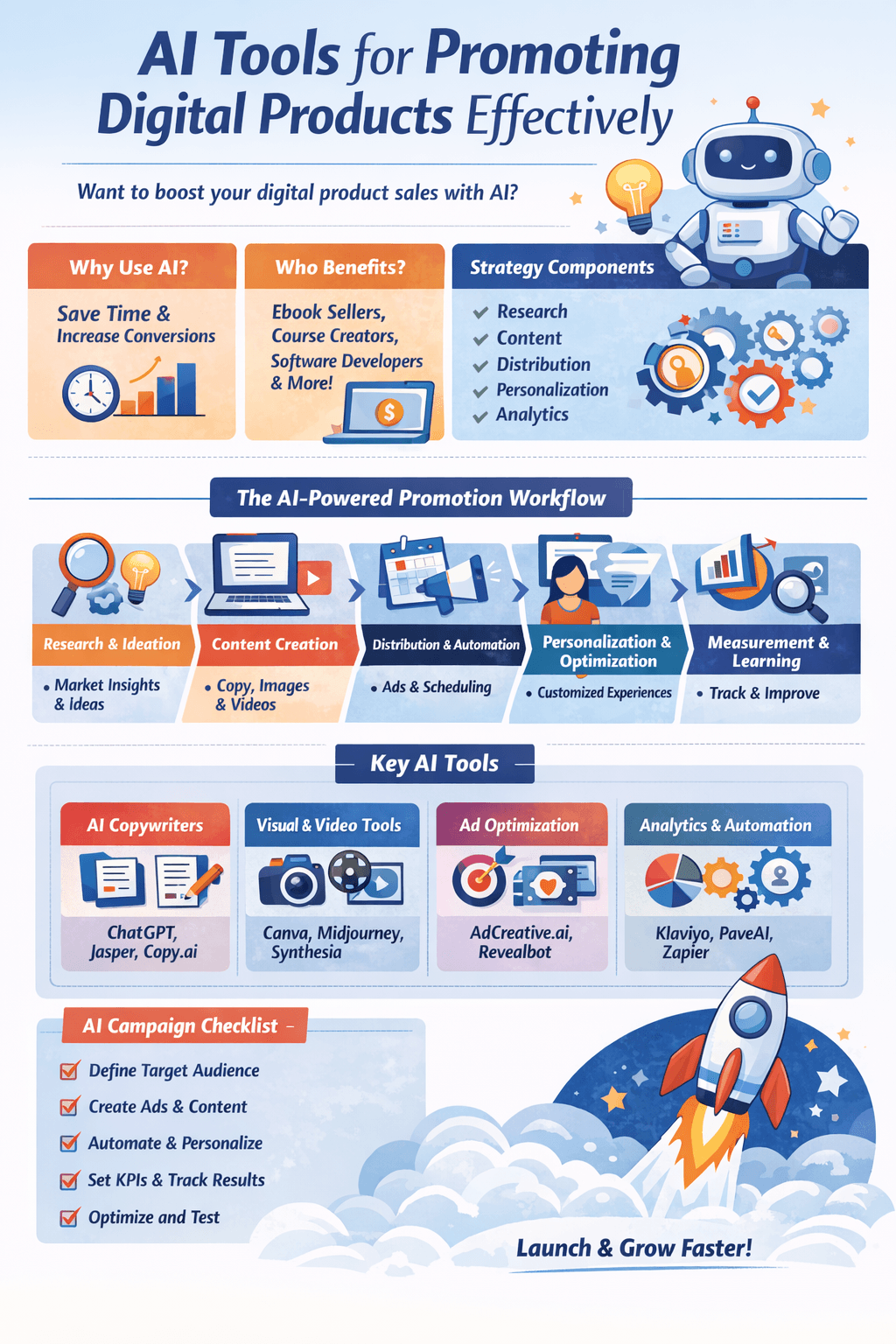
You should think of your AI-driven strategy as a system made of five components: research and ideation, content creation, distribution and automation, personalization and optimization, and measurement. Each component has AI tools that specialize in helping you perform specific tasks.
Research and ideation
AI can accelerate market research, keyword discovery, customer persona generation, and content planning. Use AI to validate ideas and discover product-market fit faster than manual surveys.
- Use generative AI to summarize reviews and competitor offerings.
- Use keyword tools with AI to find low-competition, high-intent search opportunities.
- Ask AI to generate buyer personas and likely objections so you can craft messaging that resonates.
Content creation
AI can write product descriptions, email sequences, ad copy, blog posts, landing page copy, video scripts, and design creative assets. The key is to provide clear prompts and iterate with A/B tests.
- Use large language models for copywriting and content outlines.
- Use image-generation or template design tools for visuals and thumbnails.
- Use AI voice and synthetic video tools for explainer videos and ads.
Distribution and automation
AI helps you test ad creatives, choose audiences, schedule posts, and automate workflows between systems (email, CRM, analytics). Automation reduces manual handoffs and shipping delays.
- Use ad-optimizing AI to produce multiple creatives and find high-performing combinations.
- Use automation platforms to route leads into email sequences and retargeting lists automatically.
Personalization and optimization
Personalized experiences convert better. AI can recommend content or products, customize email content per user behavior, and optimize landing pages or pricing.
- Use recommender systems to show the most relevant products.
- Use AI split-test engines to automatically route traffic to top performers.
Measurement and learning
AI analytics tools find patterns you might miss in raw data. Use them to identify which channels, messages, and creatives drive revenue, then close the loop with automated optimizations.
- Use predictive analytics to forecast campaign ROI.
- Use clustering and segmentation to improve targeting.
Core categories of AI tools to know
Below is a concise table that compares the core categories of AI tools you’ll use for promoting digital products, what they do, and when to use them.
| Category | Primary use | When to use |
|---|---|---|
| AI copywriters (Chat-based LLMs, Copy.ai, Jasper) | Generate product copy, ads, emails, blog posts | When you need scalable, varied copy quickly |
| Visual generation (Canva, Midjourney, DALL·E, Leonardo) | Create images, thumbnails, social assets | When you need custom visuals or ad creatives |
| Video and voice (Pictory, Synthesia, Descript) | Create short promo videos, voiceovers | For video ads, courses, demo clips |
| SEO & content optimization (SurferSEO, Clearscope, MarketMuse) | Optimize content for search intent | For long-form content and organic growth |
| Ad optimization (AdCreative.ai, Albert, Revealbot) | Generate creatives, optimize ad spend | For paid user acquisition campaigns |
| Email & automation (Klaviyo, Mailchimp with AI, ActiveCampaign) | Personalize emails, automate sequences | For onboarding, nurturing, promotions |
| Analytics & prediction (GA4 + Looker, Amplitude, PaveAI) | Analyze funnel, predict user behavior | For ROI analysis and segmentation |
| Personalization & recommendations (Dynamic Yield, Optimizely) | Customize landing pages and offers | For improving conversion rates |
| Chatbots & support (Intercom, Drift, Zendesk Answer Bot) | Automate support and lead qualification | For immediate engagement and lead capture |
| Integrations & automation (Zapier, Make) | Connect tools and create workflows | For automating cross-tool processes |
Choosing the right tools for your product
Selecting tools depends on budget, team skills, volume of assets needed, and channels you use. You should prioritize tools that integrate well with your stack and offer tested templates or use cases for digital product promotion.
Budget vs. value considerations
Small creators can start with lower-cost subscriptions to an LLM and a design tool to handle most needs. Companies with larger ad spends should invest in ad optimizers and analytics platforms because those yield measurable ROI.
Integration and data flow
You want tools that connect to your CRM, email platform, analytics, and payment system. This ensures campaigns can be measured and that customer data is used to personalize experiences.
Skillset and learning curve
Pick tools with good onboarding and templates if you lack technical resources. Many AI platforms have pre-built prompts and creative templates specifically for digital product promotion.
Practical AI-driven workflows
Below are example workflows that show how you can use AI at each stage of promotion. Follow these step-by-step guides to build real campaigns.
Workflow 1 — Launch a new course
- Idea validation:
- Use an LLM to summarize relevant forum threads and reviews to identify pain points.
- Use keyword AI to assess search volume and buyer intent for course topics.
- Pre-launch content:
- Generate a landing page headline, bullet benefits, and FAQs with an AI copy tool.
- Create social post variations and email sequence drafts with an LLM.
- Creatives and videos:
- Generate a course thumbnail and social images with a visual AI tool.
- Create a short promo video using an AI video generator from your course slides.
- Ads and audience targeting:
- Use an ad creative AI to produce multiple ad copy and image combinations.
- Use platform AI (Facebook/Meta, Google) to optimize targeting while feeding it enriched audience segments from your CRM.
- Automation and onboarding:
- Use automation tools to enroll buyers into an email sequence personalized by purchase intent and behavior.
- Trigger engagement messages from a chatbot to reduce refund risk.
- Optimization:
- Monitor performance with analytics AI to identify top-performing messages and pages.
- Use A/B testing service to optimize landing page variants and pricing options.
Workflow 2 — Promote a digital template bundle
- Product positioning:
- Ask an LLM to write five different positioning angles (time-saver, professional design, conversion-focused, niche-specific, affordability).
- Copy and content:
- Create product descriptions, benefits, and micro-copy for checkout with AI.
- Build blog posts and case studies demonstrating use cases and outcomes.
- Social and email:
- Use AI to produce daily social post ideas for 30 days and an email launch sequence.
- Generate urgency-based subject lines and subscriber-specific recommendations.
- Retargeting:
- Use ad optimization AI to create dynamic creatives for cart abandoners and past viewers.
- Upsell and cross-sell:
- Personalize recommendations in the checkout and thank-you page using a recommendation engine.
Copywriting with AI: prompts, templates, and testing
You will get the best results from AI copy tools when you provide precise prompts and iterate.
Prompt design best practices
- Give context about the product, target audience, tone, and conversion goal.
- Supply examples of what you like (competitor examples or your own past winners).
- Ask for multiple variations and length-specific outputs (short ad text, 50-word summary, 300-word blog intro).
Example prompt structure:
- Product overview (one paragraph)
- Target audience (demographics, pain points)
- Key benefits (3–5 bullet points)
- Call to action (what you want the user to do)
- Tone (friendly, authoritative, playful)
- Required formats (headline, social caption, email subject)
Example prompts you can reuse
- “Write five headlines for a landing page selling a 6-week course on email marketing to freelancers. Each headline must be under 12 words and highlight ‘more clients’ or ‘faster email sequences.’ Use a friendly, professional tone.”
- “Create three email subject lines for subscribers who opened previous emails but didn’t purchase, emphasizing a limited-time discount.”
- “Write ad copy variations: 2 short (90 characters), 2 medium (200 characters), and 2 long (400 characters) focusing on pain point X.”
A/B testing and iteration
You should always test multiple AI-generated variations. Use a structured A/B testing schedule: test 2–4 variations per channel, run until statistically significant results, and then iterate using the winning tone and structure.
Visuals and video: making your product look irresistible
AI image and video tools let you produce professional assets at lower cost and speed. Focus on consistent branding and testing multiple creative concepts.
Image generation vs. template tools
- Use template tools (Canva) for brand-consistent graphics and quick redesigns.
- Use generative image models (Midjourney, DALL·E) for unique hero images and concept art.
Video tools and use cases
- Use short-form video tools (Pictory, CapCut + AI captions) for social platforms.
- Use synthetic video tools (Synthesia, HeyGen) to create explainer videos without a studio.
- Use audio editing tools (Descript) to edit long-form content, remove filler words, and generate captions.
Creative testing
Run multiple thumbnail variations and short video intros; small changes in thumbnail text and color can significantly affect click-through rates.
Ads and paid acquisition with AI
AI tools optimize creatives, audience targeting, and bidding. They can test many creative combinations and find top performers faster.
How ad-optimizing AI works
- Generate multiple creatives (text, image, video) automatically.
- Run multivariate tests across targeting segments.
- Reallocate budget toward top-performing creatives in real time.
Best practices for AI-driven ad campaigns
- Provide the ad AI with historical performance data if possible.
- Start with a broad set of creatives and let AI narrow them down.
- Maintain control of budget caps and ROAS thresholds to avoid overspending.
- Keep brand safety rules in place (review generated content before publishing).
Email marketing and automation
AI personalizes subject lines, content blocks, and the sequence cadence based on user behavior patterns. This reduces churn and increases conversions.
AI features to use in email
- Subject-line generators and optimization scoring.
- Content personalization for dynamic blocks (recommendations, use-case content).
- Predictive send times and frequency optimization.
Examples of email sequences to generate with AI
- Welcome sequence: orient new customers, present the product value, invite engagement.
- Cart abandonment: offer reminders, social proof, and time-sensitive discounts.
- Upsell sequence: suggest complementary products based on purchase behavior.
Personalization and recommendation engines
Personalization increases average order value and lifetime value when it’s relevant and respectful. Use AI to recommend complementary digital products and customize landing pages.
Types of personalization
- Behavioral (based on pages viewed, time spent)
- Demographic (segment by industry, role)
- Intent-based (search queries, ad clicks)
Implementation advice
- Start with simple personalization (e.g., recommend a course based on the last course viewed).
- Monitor the impact on conversions and adjust the recommendation algorithm rules.
- Respect privacy and give users control over personalization settings.
Analytics, KPIs, and what to measure
You should define KPIs that link directly to revenue or customer value. Use AI analytics to automate insight generation and forecast outcomes.
Core KPIs for digital product promotion
- Conversion rate (landing page visitors to buyers)
- Customer acquisition cost (CAC)
- Lifetime value (LTV)
- Return on ad spend (ROAS)
- Email open and click-through rates (CTR)
- Churn or refund rate
Using AI to analyze KPIs
- Use anomaly detection to spot sudden drops or spikes.
- Use predictive models to estimate likely buyers from leads.
- Use cohort analysis to compare behavior by acquisition channel.
Table: KPI → What AI helps you do
| KPI | How AI helps |
|---|---|
| Conversion rate | Suggests page optimizations and predicts variant winners |
| CAC | Forecasts cost per acquisition by channel and audience |
| LTV | Predicts LTV per cohort for smarter ad spend |
| ROAS | Identifies optimal budget allocation across campaigns |
| Email CTR | Generates subject lines and content optimized for segments |
| Churn | Detects at-risk customers and triggers retention workflows |
Privacy, ethics, and compliance
AI-driven promotion can process sensitive user data. You must protect privacy and adhere to regulations like GDPR and CCPA.
Practical privacy steps
- Minimize data you collect and store.
- Use consent banners and clear privacy policies.
- Anonymize data when using third-party AI services.
- Review vendor compliance and data processing agreements.
Ethical considerations
- Avoid generating misleading claims about product results.
- Be transparent about AI-generated content when relevant.
- Monitor generated content for bias or inappropriate language.
Common pitfalls and how to avoid them
AI is powerful but not infallible. Avoid these common mistakes.
- Relying solely on AI without human review: always vet content for accuracy and brand voice.
- Using low-quality prompts: invest time in crafting prompts to get better output.
- Assuming automation replaces strategy: use AI to execute strategy, not create it from scratch.
- Ignoring data privacy: ensure compliance with regional laws.
Pricing and vendor selection checklist
You should evaluate vendors on more than price: consider performance, integrations, support, reliability, and roadmap.
- Does it integrate with your CRM, email, analytics, and ad platforms?
- What are the true costs (seat fees, usage, overages)?
- Is data processed in compliance with your privacy requirements?
- How responsive is support and how good are training resources?
Quick-reference tool recommendations by use case
Table: Use case → Recommended tools (examples)
| Use case | Tools (examples) |
|---|---|
| Copywriting & content | ChatGPT/GPT, Jasper, Copy.ai |
| Images & design | Canva, Midjourney, DALL·E, Leonardo |
| Short video | Pictory, CapCut, Descript |
| Synthetic video/voice | Synthesia, HeyGen, ElevenLabs |
| SEO optimization | SurferSEO, Clearscope, MarketMuse |
| Ad creative optimization | AdCreative.ai, Revealbot, Albert |
| Email & automation | Klaviyo, Mailchimp (with AI), ActiveCampaign |
| Chatbots & support | Intercom, Drift, Zendesk Answer Bot |
| Analytics & prediction | GA4 + Looker, Amplitude, PaveAI |
| Integrations | Zapier, Make |
Example campaign checklist (ready to use)
- Define target persona and primary conversion goal.
- Generate 5 headline options and 10 ad copy variations.
- Create 3 thumbnails and 2 video intros.
- Build a landing page with at least two headline/hero variants.
- Set up email onboarding with dynamic content blocks.
- Configure retargeting audiences and dynamic creatives.
- Establish KPIs and reporting cadence.
- Run A/B tests and let AI optimize budgets after initial learning.
- Review results weekly and iterate on top performers.
Final tips for maximizing AI impact
- Start small and scale: pilot on one product and one channel before expanding.
- Combine human creativity with AI speed: let AI propose ideas and humans refine them.
- Keep a prompt and creative library: store winning prompts and creative templates for reuse.
- Stay data-driven: let measurements guide decisions rather than assumptions.
- Educate your team: invest in short training sessions to get the most from each tool.
Conclusion
You can significantly improve how you promote digital products using AI by integrating generative copywriting, visual generation, video production, ad optimization, personalization, and analytics into a coherent system. Focus on clear prompts, rigorous testing, privacy compliance, and continuous measurement. With the right tools and workflows, you’ll be able to create more assets, find better-performing messages, and scale promotions with confidence.
If you want, list your product type and current channels and I’ll recommend a tailored set of tools and a starter workflow you can implement this week.