
Are you ready to make AI a practical, affordable marketing partner for your small business?
AI Strategies for Helping Small Businesses Market Online
This article outlines practical AI strategies that you can apply to market your small business online. You’ll find a mix of strategy, tactical steps, tool options, and measurable goals to help you adopt AI without wasting time or budget.
How AI Helps Small Businesses Market Online
AI helps you automate repetitive tasks, personalize customer interactions, and make smarter decisions based on data. You’ll gain speed and precision, allowing you to compete with larger players even with limited resources.
Why AI Matters for Small Business Marketing
AI reduces manual work and boosts effectiveness by turning data into action that you can use in real time. You’ll be able to reach more people with more relevant messages while spending less time on routine tasks.
Core AI Strategies for Online Marketing
This section breaks down the main AI-driven marketing strategies you should consider. Each strategy includes a short explanation and practical ways to get started.
AI-driven Content Creation
AI can help you generate blog posts, ad copy, product descriptions, and social captions faster and more consistently. You’ll produce drafts quickly, then edit them to match your brand voice so you don’t start from scratch every time.
How to start: pick an AI writing assistant, feed it clear prompts about your product or service, and refine outputs with your brand-specific details. You’ll save time and maintain a steady content cadence.
Personalization and Customer Segmentation
AI can analyze customer behavior to segment your audience and deliver personalized messages at scale. You’ll use these segments to send offers and content that feel relevant to each recipient.
How to start: use an AI-powered CRM or email platform that supports behavioral segmentation and personalized content blocks. Test small, then expand personalization once you’ve confirmed results.
Predictive Analytics and Forecasting
Predictive AI models help you forecast demand, customer churn, and campaign performance so you can plan budgets and creative strategies. You’ll reduce guesswork and allocate resources where they’re likely to pay off.
How to start: export historical sales and campaign data into a predictive tool or service and review the model’s recommendations for inventory, ad spend, and audience targeting. Adjust forecasts with your local business knowledge.
Chatbots and Conversational AI
Chatbots can handle common customer questions, schedule appointments, and capture leads 24/7 without requiring constant staff attention. You’ll provide faster responses and free your team for higher-value interactions.
How to start: configure a chatbot with FAQ responses, order lookup, and lead collection flows, and integrate it with your CRM or booking system. Monitor transcripts and retrain the bot on missed queries.
Programmatic Advertising
AI optimizes bidding and ad placements across channels to reach high-value prospects at the best price. You’ll benefit from automated adjustments that respond to real-time signals like time of day, device, and audience behavior.
How to start: use platforms that support automated bidding and dynamic creative optimization, set clear ROI targets, and let the system learn while you monitor performance.
SEO and Content Optimization
AI tools analyze search intent, recommend keywords, and optimize content structure for better organic visibility. You’ll find content gaps and technical SEO fixes more quickly than manual review alone.
How to start: run an SEO audit with an AI-backed tool, prioritize high-impact fixes, and use AI to suggest content topics and on-page improvements.
Social Media Management and Listening
AI can schedule posts, suggest captions, analyze engagement trends, and monitor brand mentions across platforms. You’ll maintain a consistent presence and respond proactively to customer sentiment.
How to start: use a social scheduling tool with AI captioning and listening features, set alerts for brand mentions, and create a simple response playbook for common scenarios.
Email Marketing Automation
AI refines subject lines, send times, and content to boost open and click-through rates. You’ll segment audiences dynamically and run drip campaigns that adapt to user behavior.
How to start: choose an email platform with AI-based optimization, set up triggered flows (welcome series, cart abandonment, re-engagement), and use A/B tests to confirm improvements.
CRM and Lead Scoring
AI-powered lead scoring ranks prospects based on conversion likelihood so you can focus on high-value leads. You’ll spend sales time more efficiently and reduce the noise from low-quality inquiries.
How to start: integrate your CRM with lead-scoring models that weigh behavior and demographics, then route top leads to sales for rapid followup.
Visual Content Generation
AI image tools can create banners, product mockups, and social visuals based on your prompts and brand guidelines. You’ll shorten creative cycles and reduce dependency on expensive photoshoots for every asset.
How to start: use a visual AI tool for drafts and combine outputs with simple design editors for brand consistency.
Website Optimization and A/B Testing
AI can suggest variations for landing pages and automatically route traffic to the highest-performing versions. You’ll improve conversion rates without needing deep technical expertise.
How to start: implement tools that support multivariate testing and AI-driven personalization to show different content to different audience segments.
Voice and Local Search Optimization
AI helps you optimize for voice search queries and local discovery by analyzing conversational search patterns. You’ll reach customers who use mobile voice assistants and local maps.
How to start: focus on natural language phrases in FAQs and local schema markup, and ensure your business info is consistent across directories.
Reputation Management and Review Analysis
AI can aggregate reviews, analyze sentiment, and highlight common praise or complaints so you can act quickly. You’ll protect and improve your reputation by responding with targeted fixes.
How to start: set up automated review monitoring and alerts, and create templated but personalized responses to common review themes.
Pricing and Promotions Optimization
AI models can suggest optimal pricing and promotional timing by analyzing competitor pricing, inventory levels, and customer demand. You’ll protect margins while staying competitive.
How to start: pilot AI-based pricing on a subset of products or services and monitor margin impact and sales volume changes.
Competitor Analysis and Market Research
AI scrapes public data to summarize competitor campaigns, pricing moves, and product features so you can respond faster. You’ll base your decisions on real market signals rather than intuition alone.
How to start: set alerts for competitor mentions and use AI tools to summarize competitor changes and suggest countermeasures.
Customer Journey Mapping
AI visualizes typical customer paths across touchpoints and identifies friction points for improvement. You’ll understand where prospects drop off and which interactions drive conversions.
How to start: integrate data from website analytics, CRM, and ad platforms to build a composite journey, then prioritize low-effort changes that remove friction.
Data Privacy and Compliance
AI can help you maintain compliance by anonymizing data, monitoring consent, and flagging risky data transfers. You’ll protect customer trust and reduce regulatory exposure by building privacy checks into your processes.
How to start: audit your data collection and storage, implement consent mechanisms, and use AI tools that support compliance reporting.
Comparing AI Tools by Function
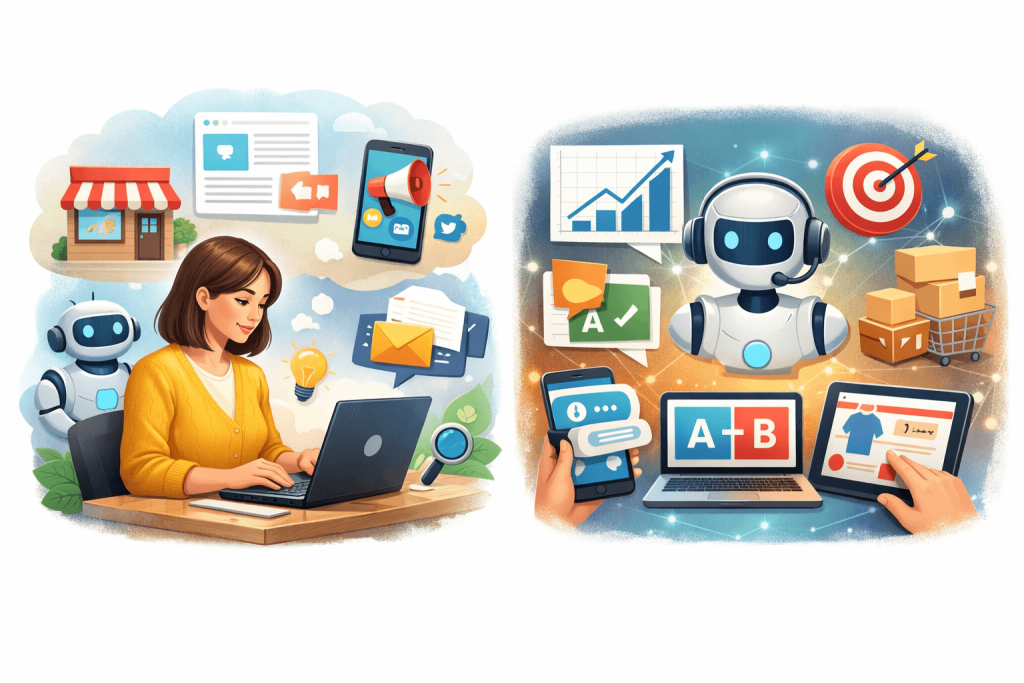
This table compares common AI tool categories and representative tools you might consider. You’ll use this to match tools to your business needs and budget.
| Function | Example Tools | Cost Level | Best For |
|---|---|---|---|
| Content generation | OpenAI (ChatGPT), Jasper, Copy.ai | Low–Medium | Blog drafts, ad copy, product descriptions |
| Visual generation | Canva, DALL·E, Midjourney | Low–Medium | Social visuals, thumbnails, mockups |
| Chatbots / Conversational AI | ManyChat, Tidio, Drift | Low–Medium | Lead capture, customer service, booking |
| Analytics / Insights | Google Analytics, Looker, Piwik PRO | Low–High | Traffic analysis, attribution, reporting |
| Email automation | Mailchimp, Klaviyo, ActiveCampaign | Low–Medium | Newsletters, flows, personalization |
| Social scheduling & listening | Hootsuite, Buffer, Sprout Social | Low–Medium | Scheduling, sentiment monitoring |
| SEO & keyword tools | SEMrush, Ahrefs, Moz | Medium–High | Keyword research, audits, content gaps |
| CRO / A/B testing | Optimizely, VWO, Google Optimize | Low–High | Landing page testing, personalization |
| CRM with AI | HubSpot, Salesforce Einstein | Medium–High | Lead scoring, lifecycle automation |
Implementing AI: A Practical Roadmap
This section gives you step-by-step guidance for adopting AI without getting overwhelmed. Each step is brief and action-oriented so you can move forward quickly.
1. Assess Your Business Needs
Start by listing your biggest marketing bottlenecks and measurable goals. You’ll be able to prioritize AI use cases that will impact revenue or customer experience most.
2. Check Your Data Quality
AI performs best with clean, structured data. You’ll need to consolidate customer records, fix duplicates, and ensure consistent labeling before training models.
3. Choose One High-Impact Use Case
Pick a single area where AI can create quick wins, such as improving email open rates, automating FAQs, or optimizing ad bids. You’ll build confidence and learn lessons without large commitments.
4. Select Tools and Partners
Match a tool to your use case, budget, and technical capacity. You’ll often find cloud-based SaaS tools that require minimal setup and deliver fast results.
5. Run a Small Pilot
Configure a limited test, measure outcomes, and compare against your baseline. You’ll use this proof to justify broader rollout.
6. Integrate with Existing Systems
Link AI tools to your CRM, website, and analytics stack to ensure seamless data flow. You’ll get better personalization and more accurate measurement.
7. Train Your Team
Give your staff short training on how to use AI outputs and how to provide feedback to the system. You’ll reduce resistance and improve results by combining human judgment with AI speed.
8. Define KPIs and Reporting
Set clear metrics and monitoring cadence for each pilot. You’ll track ROI more reliably and identify problems early.
9. Scale Gradually
Roll successful pilots into larger programs and replicate proven approaches across channels. You’ll scale what works and stop what doesn’t without wasting money.
10. Iterate and Optimize
Treat AI programs as experiments. You’ll continuously tune models, prompts, and creative based on performance data.
KPIs and How to Measure ROI
Choosing the right KPIs helps you understand whether AI investments are paying off. Below are common metrics mapped to strategies with examples of how to measure them.
| Strategy | Primary KPIs | How to Measure |
|---|---|---|
| Email Automation | Open rate, CTR, conversion rate | Platform analytics; track campaign to sale |
| Chatbots | Response time, resolution rate, lead volume | Chat transcripts; CRM lead attribution |
| Content AI | Organic traffic, time on page, leads | Google Analytics; content-attribution tools |
| Programmatic Ads | CPA, ROAS, CTR | Ad platform reporting and conversion tracking |
| SEO Optimization | Rankings, organic sessions, CTR | Rank trackers; Google Search Console |
| Social AI | Engagement rate, follower growth, leads | Native analytics and UTM-tagged links |
| CRO / A/B Testing | Conversion rate, lift, revenue per visitor | Testing platform reports and revenue tracking |
How to calculate basic ROI: compare revenue lift or cost reduction attributable to the AI project against the total cost (subscription fees, implementation, staff time). You’ll track payback period and ongoing profitability.
Common Pitfalls and How to Avoid Them
Adopting AI without a plan can waste time and money, but you can avoid common traps with practical safeguards. You’ll learn the risks and how to manage them.
Overreliance on Automation
If you automate everything, your messaging can become robotic and lose human empathy. You’ll keep critical human review steps for high-stakes communications, like complaints and major offers.
Poor Data Hygiene
Garbage data gives you garbage results and misleading predictions. You’ll schedule regular data cleanup and standardize fields to maintain quality.
Lack of Measurement
Without baseline metrics, you won’t know if AI produces real gains. You’ll set clear KPIs before launching any AI initiative.
Ignoring Privacy and Compliance
AI that mishandles customer data can create legal risk and damage trust. You’ll implement consent management and anonymize data where possible.
Choosing the Wrong Tools
Buying a flashy AI product without matching it to your needs wastes budget. You’ll pilot affordable tools first and reserve advanced platforms for clear ROI cases.
Poor Staff Adoption
If your team doesn’t use the tools, they won’t deliver value. You’ll involve frontline staff early and provide short, practical training sessions.
Budgeting and Cost Considerations
AI doesn’t have to be expensive, and you can start small while keeping an eye on scalability. This section outlines cost tiers and lean strategies.
Low Budget Options
Use free or low-cost tiers of popular tools, open-source models, and automation platforms with pay-as-you-go pricing. You’ll get meaningful benefits from content generation, basic chatbots, and scheduling without large upfront fees.
Mid Budget Options
Subscribe to integrated platforms that bundle analytics, CRM, and automation. You’ll reduce manual integration work and gain more mature features like predictive analytics.
Higher Budget Options
Invest in custom model training, advanced analytics platforms, and full-service agencies if you need industry-specific models or significant scale. You’ll expect higher ROI if the use case impacts revenue directly.
Practical tip: start with low-cost pilots for 30–90 days and use results to justify larger investments.
Small Business Use Cases and Examples
Realistic examples help you imagine how to apply AI to your own business. These are short, actionable scenarios you could replicate.
Local Bakery: Increase Foot Traffic
Use AI to schedule targeted social posts promoting weekly specials and use a chatbot for online preorders. You’ll analyze which promotions drive walk-ins and refine offers accordingly.
E-commerce Store: Raise Conversions
Implement AI product recommendations and dynamic pricing to increase average order value. You’ll test different recommendation algorithms and measure lift via A/B testing.
Service Provider (Plumber, Consultant): Capture Leads
Add a chatbot to your website to triage requests and schedule appointments, and use an AI-powered email flow for lead nurturing. You’ll reduce missed calls and convert more first-time visitors.
Apparel Brand: Improve Creative Output
Use AI image generation to create seasonal mockups and A/B test creatives across ad platforms. You’ll iterate faster on visual concepts and identify winners sooner.
Ethics, Transparency, and Customer Trust
Using AI responsibly protects your brand and builds trust with customers. You’ll want to be transparent about AI use and prioritize customer consent and fairness.
Best practices: disclose when customers interact with bots, avoid deceptive personalization, and review outputs for bias or inappropriate language. You’ll maintain credibility by combining AI speed with human oversight.
Security and Data Governance
AI initiatives require careful attention to data security and governance to protect customer information. You’ll create clear policies and limit data exposure.
Steps to secure AI: encrypt data in transit and at rest, use role-based access to tools, and maintain an audit trail for model changes and data usage. You’ll reduce risk and comply with common regulations.
Checklist Before Launching an AI Marketing Project
This checklist helps you avoid common oversights and launch smoothly. You’ll use it to confirm readiness before deploying any AI tool.
- Define clear business objective and KPIs.
- Audit and clean relevant data sources.
- Select pilot tool(s) and validate costs.
- Integrate with CRM/analytics where possible.
- Train staff and document workflows.
- Set up monitoring, alerts, and reporting cadence.
- Ensure privacy, consent, and security controls.
- Plan a 30–90 day test and evaluation period.
Troubleshooting and Continuous Improvement
Even small projects can hit snags, and knowing how to course-correct helps you scale successfully. You’ll adopt an iterative mindset and treat AI systems as evolving tools.
Common fixes: retrain models when performance drops, refine prompts for better content, increase data inputs to improve predictions, and re-segment audiences if engagement falls. You’ll schedule regular reviews to keep systems aligned with business changes.
Final Steps: Putting It All Together
Start with a single, measurable use case and build outward once you see results. You’ll reduce risk, optimize spend, and create a repeatable process for AI adoption across marketing.
Take these immediate actions this week: pick one channel (email, social, chatbot), choose a low-cost AI tool to test, and define a clear metric to measure after 30 days. You’ll be surprised how quickly small changes can compound.
Conclusion
AI offers practical ways to help you market online more effectively, from automating routine work to personalizing customer experiences and predicting outcomes. You’ll benefit most by starting small, measuring carefully, and combining AI outputs with human judgment.
If you follow the roadmap and prioritize high-impact, low-effort pilots, you’ll build confidence and momentum that can transform how your business attracts and retains customers.