
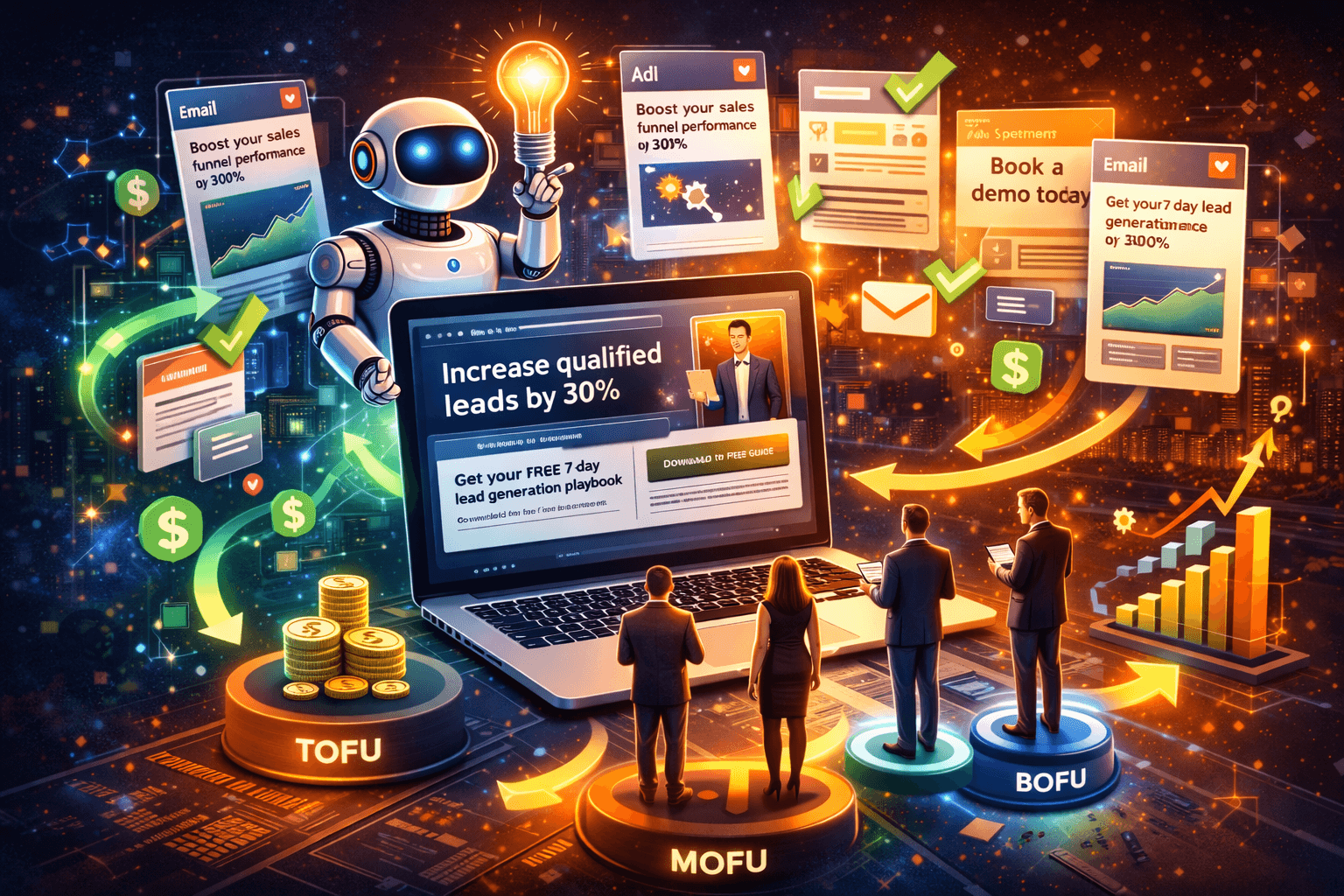
Want to use AI to write high-converting funnel copy that actually brings in qualified leads and moves them through your marketing stages?
Using AI to Create Funnel Copy for Lead Generation That Converts
You can use AI to speed up writing, test variations rapidly, and tailor messages to different audience segments. This guide helps you understand how to plan, prompt, optimize, and measure AI-generated funnel copy so your lead generation performs better and you spend less time rewriting.

Why funnel copy matters for lead generation
Your funnel copy is the set of messages that take a stranger to a lead, and ideally to a customer. When your copy resonates, you increase conversions at every stage: ad clicks, landing page opt-ins, email opens, and demo requests. If your copy misses the mark, your funnel leaks.
What AI brings to funnel copywriting
AI accelerates idea generation, creates consistent voice across channels, and helps you generate multiple variations for testing. You can create headlines, body copy, email sequences, and ad variations in minutes, then refine with human insight so copy feels authentic and targeted.
When to use AI and when not to
AI is excellent for rapid drafting, experimenting with tone, and producing many variants for split testing. You should avoid relying on AI for final legal or highly niche technical claims without verification. Use AI as your creative assistant, not the single source of truth.
How funnels are structured: TOFU, MOFU, BOFU
You need to map copy to each funnel stage so your messaging feels relevant.
- TOFU (Top of Funnel): Awareness content that attracts attention and communicates a problem you solve.
- MOFU (Middle of Funnel): Consideration content that builds trust and positions your solution.
- BOFU (Bottom of Funnel): Decision-focused content that reduces friction and encourages conversion.
Table: Funnel stages and primary copy goals
| Funnel Stage | Primary Goal | Typical Content Types | Tone/Focus |
|---|---|---|---|
| TOFU | Attract & educate | Ads, social posts, blog headlines, short videos | Curious, helpful, problem-focused |
| MOFU | Build trust & qualify | Landing pages, lead magnets, webinars, case studies | Credible, value-driven, empathetic |
| BOFU | Convert & reduce friction | Sales pages, pricing pages, email nurture, demo CTAs | Confident, direct, benefit-focused |
Start with audience and offer clarity
Before you ask AI to write, you should be crystal clear on who you’re talking to and what you’re offering. AI performs best when you provide precise inputs: audience persona, pain points, the offer, evidence, and tone.
- Define 1–3 buyer personas with demographics, goals, frustrations, and buying triggers.
- Describe the lead magnet or offer (what it is, format, immediate benefit).
- List key social proof elements: testimonials, results, logos, stats.
Persona example to feed AI
Provide a compact persona for the AI so it writes relevant copy.
- Persona name: Growth-Minded Marketing Manager
- Age: 28–40
- Company: SaaS, 20–200 employees
- Pain: Low qualified lead volume, inefficient ad spend
- Goal: Increase MQLs by 30% in 6 months
- Objections: Budget constraints, fear of complex implementation
Use this to make sure AI writes with the right angle.
Choosing the right AI tool
There are many tools: large language models (LLMs) via APIs, copy-focused editors with built-in templates, and specialized headline or email generators. Choose based on your needs:
- If you need customization and integration: use an LLM API like GPT via a platform that lets you control prompts and data.
- If you want templates and less setup: use a copy tool that specializes in ads and email sequences.
- If you must ensure compliance and style: choose a solution with enterprise governance.
Table: Quick tool comparison
| Use Case | Recommended Tool Type | Why |
|---|---|---|
| Rapid ad headline A/B tests | Copy generator apps | Templates, speed |
| Integrated workflow and CRM syncing | LLM API + automation | Custom logic, scalable |
| Multi-language funnels | Models with translation support | Consistent voice across languages |
| Strict compliance industries | Enterprise tools with auditing | Logging and guardrails |
Prompt engineering: how to brief AI for funnel copy
Your prompts are the most important lever. A detailed, structured prompt reduces revision time.
Essentials to include:
- Persona summary (1–2 sentences)
- Desired funnel stage (TOFU/MOFU/BOFU)
- Offer description and format
- Concrete CTA (what you want the user to do)
- Tone and length
- Constraints (no jargon, legal notes, character limits)
Example prompt for a landing page hero:
“Write a 20–30 word headline and 1–2 sentence subheadline for a landing page targeted to Growth-Minded Marketing Managers at SaaS companies (age 28–40). Offer: a free 7-day lead generation playbook that increases qualified leads. Tone: confident and helpful. CTA: ‘Download the Free Playbook’. Avoid marketing clichés and keep jargon minimal.”
You’ll get better results when you offer examples of desired style and unacceptable phrases.
Creating high-converting headlines with AI
Headlines are a primary determinant of performance because they form the first impression. Use AI to produce many headline variants and then filter by these criteria:
- Clarity over cleverness
- Concrete benefit or solution
- Specificity (numbers, timeline)
- Emotion or curiosity pinch
Try iterative prompting: produce 20 headlines, ask AI to rank the top 5 by urgency or clarity, then further refine the top 3.
Table: Headline variation strategy
| Variation Type | Prompt Example | When to Use |
|---|---|---|
| Benefit-based | “Increase qualified leads by 30% in 3 months” | When you have a measurable result |
| Question-based | “Tired of wasting ad spend on unqualified leads?” | For TOFU social ads |
| Time-based | “Get a 7-day plan to fix lead flow” | For urgency and immediacy |
| Social proof | “Trusted by 200+ SaaS marketers” | On landing pages with logos |
Drafting landing page copy with AI
When building landing pages, structure the copy to move prospects logically:
- Hero: headline + subheadline + single clear CTA
- Problem section: empathize and explain consequences
- Solution section: introduce your offer and key benefits
- Features/what’s inside: bullet points for the lead magnet or product
- Social proof: testimonials, metrics, logos
- CTA repeated with urgency or scarcity
Feed AI the structure and ask for copy for each section. Example:
“Write a 40–60 word ‘Problem’ paragraph that empathizes with the persona’s frustration with low-quality leads, then a 40–60 word ‘Solution’ paragraph describing the playbook and what it contains.”
AI can also create bullet lists that are scannable and benefit-led.
Writing lead magnet copy that converts
Your lead magnet must be positioned as a quick, tangible win. Use AI to test different value propositions: a checklist, a playbook, a template, or a calculator. Frame the magnet for ROI:
- Convey what user will get and how long it takes to see value.
- Provide a clear CTA and describe format (PDF, Google Doc, video).
- Use micro-commitments: “Save this checklist,” “Complete in 15 minutes.”
Create multiple formats with AI (short checklist vs. detailed guide) to see what attracts your audience.
Email nurture sequences: prompts, cadence, and personalization
Email sequences are where leads get qualified and warmed up. Use AI to draft sequences and tailor them to each stage.
Common sequence structure:
- Welcome/Deliver (Day 0): thank you and deliver magnet
- Value follow-up (Day 2–3): quick tip or case study
- Problem-heavy email (Day 5): amplify pain and introduce solution
- Social proof email (Day 7): testimonial or result
- Offer/CTA email (Day 10): invite to demo or trial
- Re-engagement (Day 14+): last attempt with urgency
Prompt example for first email:
“Write a friendly and concise welcome email (80–120 words) to deliver the ‘7-Day Lead Gen Playbook’. Include a short summary of what’s inside, a clear download link CTA, and one tip to get started in 2 minutes.”
Use AI for subject line variations and preheader text too. Then A/B test subject lines and CTAs.

Table: Sample email sequence and aim
| Email # | Timing | Main Aim |
|---|---|---|
| 1 | Immediately | Deliver magnet, set expectations |
| 2 | 2–3 days | Provide actionable tip, show quick win |
| 3 | 5–7 days | Share case study, build trust |
| 4 | 10 days | Present demo or trial CTA |
| 5 | 2 weeks | Re-engage or archive |
Ads and creative copy for TOFU
AI is very useful for generating ad headlines and descriptions across platforms (Google, Facebook, LinkedIn). Give AI context about platform norms and character limits.
When prompting:
- Specify platform and character limit
- Provide desired CTA and landing page focus
- Include buyer persona and key pain point
Ask AI to produce multiple headline-description combinations that you can plug into ad platforms for rotation.
Personalization and segmentation strategies using AI
You can personalize copy by segmenting leads based on behavior, firmographics, or content interactions. Use AI to generate versions of copy for each segment:
- Job title variations: “Marketers” vs. “CMOs”
- Company size: “Startups” vs. “Enterprises”
- Industry: SaaS vs. eCommerce
AI can rewrite headlines and email intros with minimal changes, keeping the benefit consistent while matching the recipient’s context.
Testing and optimization: the AI-enhanced approach
AI lets you create many variants quickly, but the real work is testing and analyzing. Implement a structured testing plan:
- Start with hypothesis (e.g., specificity increases CTR)
- Create 3–5 variants with AI (headline, subheadline, CTA)
- Run A/B or multivariate tests with meaningful sample size
- Track micro-conversions (clickthrough, time on page, opt-in rate)
- Iterate based on data, then retest
Use statistical significance calculators to know when to pick a winner.
Measuring what matters: KPIs for funnel copy
Track these KPIs at each funnel stage so you know which copy is helping or hurting.
- TOFU: CTR on ads, landing page visits, bounce rate
- MOFU: Opt-in rate, lead quality score, demo bookings
- BOFU: MQL-to-SQL conversion, trial activation, close rate
- Post-conversion: LTV (lifetime value), churn
Use attribution models to tie copy changes to revenue impact.
Handling regulatory and brand constraints
If you operate in regulated industries (finance, health), you should not let AI generate unvetted claims. Create guardrails:
- Provide AI with a style guide and forbidden claims list
- Review AI outputs with legal/compliance before publishing
- Use enterprise AI tools with logging and approval workflows
For brand consistency, use a brand voice template in your prompt that includes do’s and don’ts.
Human-in-the-loop: editing and tone calibration
AI drafts will need human editing for accuracy, nuance, and brand fit. You should:
- Verify factual claims and metrics
- Reduce generic phrasing and inject authenticity
- Ensure CTAs are actionable and linked to clear next steps
- Add personalization tokens for automation platforms
Make editing a standard step in your process, not an afterthought.
Example prompts and templates you can reuse
Below are reusable prompt templates. Replace bracketed fields with your specifics.
- Landing page hero: “Write a [30–40 word] headline and [1–2 sentence] subheadline for a landing page targeted at [persona]. Offer: [lead magnet]. Tone: [tone]. CTA: [CTA text].”
- Email welcome: “Write a [90–120 word] welcome email to deliver [magnet]. Include a short summary, a download link, and one quick tip to get started in under 5 minutes. Tone: [friendly/helpful/concise].”
- Ad headline: “Generate 10 Google search headlines (max 30 characters) and 5 description lines (max 90 characters) promoting [offer] to [audience]. Emphasize [main benefit].”
Use these as starting points and refine for your brand.
Sample copy for each funnel stage
Here are concise examples to give you a practical sense of AI-generated outputs. Use them as starting points and tailor to your numbers and voice.
- TOFU Ad Headline: “Stop wasting ad spend on unqualified leads”
- TOFU Landing Hero: “Get qualified leads that convert — a 7-day playbook for SaaS marketers”
- MOFU Email Subject: “A quick case study: how one team cut CPL by 40%”
- BOFU Landing CTA: “Book a 15-minute demo — see how it works”
These short examples are meant to be tested and localized to your audience.
Common pitfalls and how to fix them
Even with AI, missteps can happen. Here are common issues and solutions:
- Problem: Copy feels generic or bland. Fix: Add specific metrics, named customer examples, and vivid benefits in the prompt.
- Problem: Too many CTA options confuse visitors. Fix: Use a single primary CTA and one secondary, lower-priority CTA.
- Problem: AI-generated claims are unverified. Fix: Add a verification step and require sources or proof for every claim.
- Problem: Poor subject lines. Fix: Ask AI for emotional and curiosity-driven alternatives and A/B test them.
Workflow example: from brief to live campaign
- Brief: Create a short creative brief with persona, offer, and KPIs.
- Generate: Use AI to create 10 headline variants and 3 landing page drafts.
- Curate: Choose 2 headline winners and refine with human edits.
- Test: Launch ad variants with rotation; split test landing pages.
- Analyze: Review metrics after statistically-significant sample size.
- Iterate: Update copy based on winners and scale.
This repeatable cycle helps you continuously improve conversion rates.
Cost and efficiency considerations
AI reduces the time to produce copy, but not the time to strategize or test. Budget for:
- Tool subscriptions or API costs
- Human editor time for review and refinement
- Analytics and testing platform fees
Often, the ROI comes from faster testing cycles and improved conversion rates rather than just cheaper copy.
Ethics and authenticity with AI-generated copy
You should be transparent and avoid deceptive tactics. Don’t fabricate testimonials or results. Use AI to paraphrase quotes only if you have permission, and always be honest about outcomes. Authenticity builds long-term trust and higher-quality leads.
Scaling personalized funnels with AI and automation
When you scale, you’ll rely on automation to personalize at scale. Steps to scale responsibly:
- Create modular copy blocks for different segments
- Use tokens and conditional logic in your automation platform
- Test personalization variations (e.g., title vs. company name vs. pain point)
- Monitor performance by segment to ensure personalization helps, not harms
AI can generate the blocks; your automation system assembles them.
Advanced techniques: fine-tuning and few-shot learning
If you have technical capabilities, you can fine-tune models on your brand voice and historical high-performing copy. This yields higher relevance and fewer editing passes. Few-shot prompting (providing 3–5 examples of great copy) also improves outputs without full fine-tuning.
Security and data privacy
Never feed personally identifiable information (PII) into public AI endpoints unless your vendor supports data protections. Use enterprise models and on-premise solutions if privacy is a concern. Log outputs and maintain version history for audits.
Examples of prompts and expected outputs table
| Prompt Type | Prompt Example | Expected Output |
|---|---|---|
| Ad headline | “Create 6 ad headlines for [SaaS persona], 30 chars max, emphasize 30% lead increase.” | 6 short, benefit-focused headlines ready for ad rotation |
| Landing hero | “Write hero headline + subheadline for lead magnet ‘7-day playbook’ targeting marketing managers.” | 1 headline (20–30 words) + 1 subheadline (1–2 sentences) |
| Email series | “Generate a 5-email nurture sequence for a lead who downloaded the playbook.” | 5 subject lines + 5 email bodies with CTAs and suggested send cadence |
Final checklist before publishing AI-generated funnel copy
- Is the persona clear and reflected in the copy?
- Are benefits specific and quantified where possible?
- Is there one clear CTA per page/email?
- Have you included social proof and trust signals?
- Did compliance/legal review any claims that require verification?
- Are tracking pixels, UTM tags, and conversion events set up?
- Is there an A/B testing plan with clear success metrics?
What to expect in performance improvements
You should expect faster ideation and more variants to test, which generally leads to incremental improvement in conversion rates. Typical early wins include improved CTRs on ads and small uplift in opt-in rates, but real gains come from disciplined testing and iteration.
Conclusion: how you can get started today
You can begin by creating a short creative brief for one lead magnet, generating 10 headlines and 3 landing page drafts with AI, and launching a small A/B test. Keep a human editor in the loop for final polish and ensure metrics are tracked. With consistent testing and data-driven iteration, AI can become a multiplier for your funnel copy efforts and help you generate better-quality leads more efficiently.
If you’d like, you can share a persona and offer now, and you’ll get a set of tailored prompts and sample headlines to use immediately.