
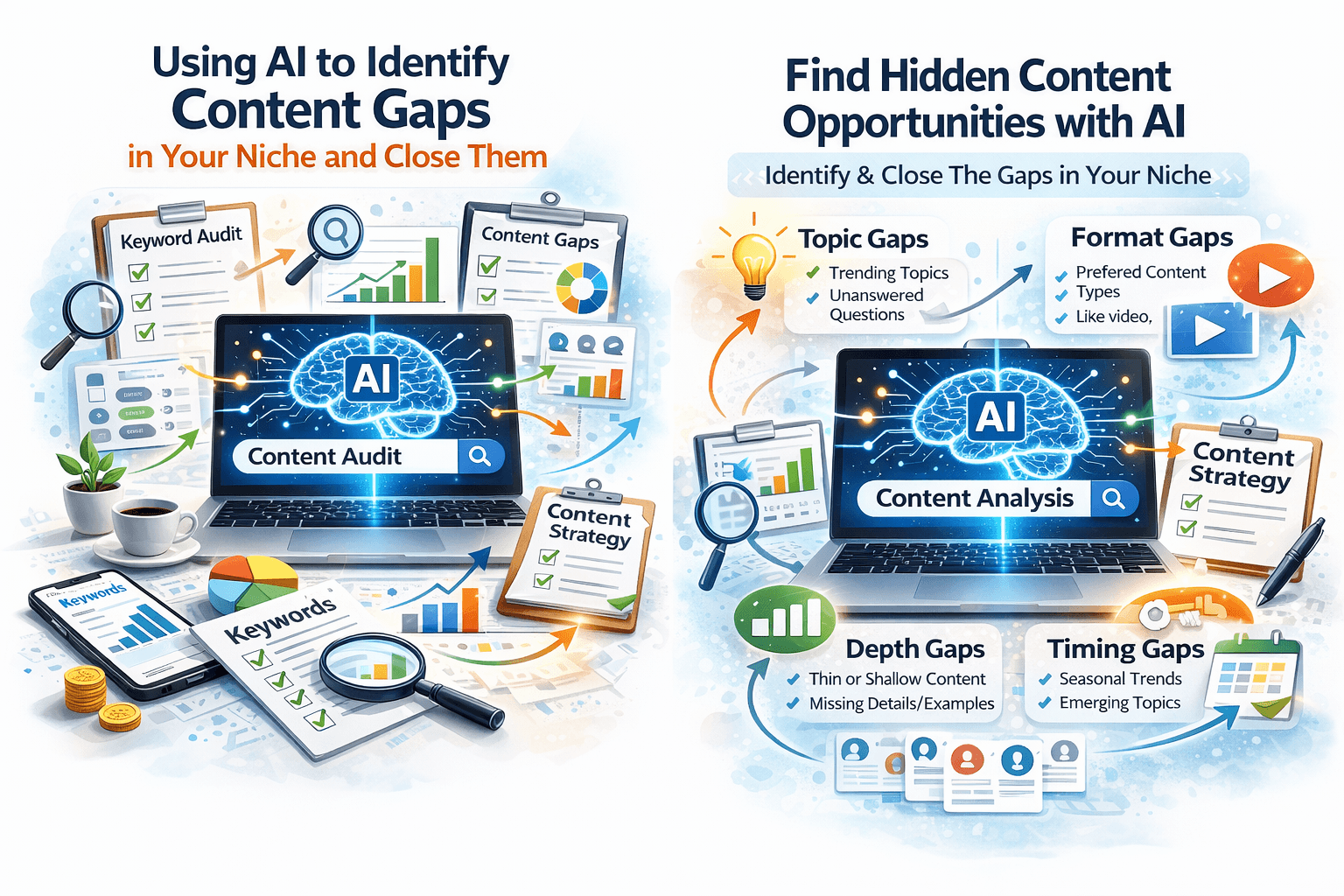
Are you sure your content strategy is covering everything your audience needs, or are there hidden opportunities you could be missing?
Using AI to Identify Content Gaps in Your Niche and Close Them
This article shows how you can use AI to find the missing pieces in your niche and create content that truly answers user needs. You’ll learn step-by-step methods, the best tools to use, and practical workflows you can apply right away.
Why identifying content gaps matters
Identifying content gaps helps you create higher-value content that attracts traffic, builds trust, and converts readers into customers. When you close gaps, your content becomes more relevant and authoritative for your niche.
What a content gap actually is
A content gap is any topic, question, or format that your audience cares about but that either doesn’t exist or is poorly addressed on your site or within your niche. Gaps can be topical, intent-based, or format-related.
How AI changes the game for content gap analysis
AI can process huge amounts of data quickly and find patterns you’d miss manually. You can use AI to analyze search results, competitor content, user behavior, and social conversations to pinpoint gaps with precision.
Types of content gaps you can find with AI
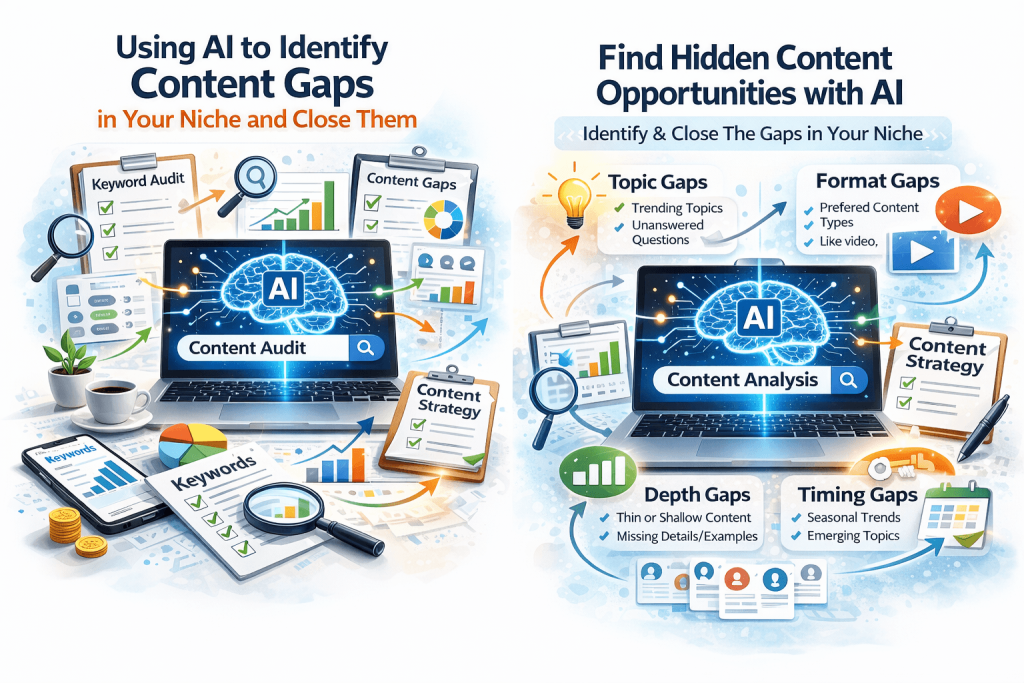
There are several kinds of gaps you can identify using AI, including topic gaps, intent gaps, depth gaps, format gaps, and timing gaps. Each type requires a slightly different approach to discover and address effectively.
Topic gaps
Topic gaps are missing subjects that users want information about. AI topic modeling and clustering can reveal frequently asked or trending topics that are undercovered in your niche.
Intent gaps
Intent gaps occur when content exists but doesn’t match the searcher’s intent—informational, navigational, commercial, or transactional. AI can classify search intent and show where your content misaligns with user needs.
Depth gaps
Depth gaps happen when content mentions a topic but lacks depth, examples, or actionable steps. Natural language processing (NLP) tools can evaluate content depth by comparing entity coverage and subtopics across pages.
Format gaps
Format gaps appear when your content doesn’t match preferred content types, like video, interactive tools, templates, or long-form guides. AI-driven audience analysis can reveal format preferences based on engagement signals.
Timing gaps
Timing gaps are seasonal or trend-driven opportunities your content calendar misses. Predictive AI models can forecast rising topics or seasonal demand so you can prepare content in advance.
The data sources AI uses to find gaps
AI can ingest many data types that reveal content opportunities, including search engine results, analytics data, social media, Q&A sites, forums, competitor websites, and customer feedback. Each source adds a different signal to help you prioritize.
Search engine data
Search engine result pages (SERPs) reveal what people search for and the content types that rank. AI can parse SERP features, related searches, and ranking patterns to identify unsolved queries.
Website analytics
Your analytics data—pageviews, bounce rates, time on page, and conversion rates—shows which pages underperform. AI can detect patterns that suggest content needs improvement or expansion.
Social listening and community forums
Social networks, Reddit, and niche forums are raw sources of user questions and frustrations. AI can aggregate sentiment and topic frequency to highlight recurring user needs.
Competitor content
Examining competitor content helps you see what others cover well and where they fall short. AI compares coverage, structure, and depth across many competitors to find your competitive advantage.
Q&A sites and support tickets
Q&A platforms and internal support tickets contain real user questions and pain points. AI-driven categorization and clustering can transform that unstructured text into prioritized content ideas.
Tools and platforms that help you find content gaps
There are many AI tools for content gap analysis, from specialized SEO suites to general-purpose NLP services. Below is a comparison table of common categories and examples to help you choose.
| Tool category | Examples | What it helps you do |
|---|---|---|
| SEO platforms | Ahrefs, SEMrush, Moz | Keyword gap analysis, SERP feature detection, competitor comparison |
| Topic modeling/NLP | OpenAI, Hugging Face, MonkeyLearn | Cluster topics, extract entities, classify intent |
| Social listening | Brandwatch, Sprout Social, Mention | Find trends, sentiment, and frequently asked questions |
| Analytics & CDP | Google Analytics, GA4, Amplitude | Identify user behavior gaps, underperforming pages |
| Content brief generators | SurferSEO, MarketMuse, Frase | Build briefs with AI-suggested headings, keywords, and depth |
| Custom ML tools | Python + spaCy/Transformers | Tailor analysis to unique data and workflows |
A practical workflow to identify content gaps with AI
This workflow gives you a repeatable process you can adapt to any niche. Each step explains the AI techniques and outputs you’ll get.

Step 1 — Collect and consolidate data
Gather search queries, analytics, competitor URLs, social mentions, and support tickets into a single dataset. Use scraping tools, APIs, and analytics exports to centralize the data for AI processing.
Step 2 — Normalize and clean the data
Clean duplicate queries, normalize text, and tag content with metadata like date, source, and intent. Clean data prevents noise from skewing AI results and improves clustering accuracy.
Step 3 — Run topic modeling and clustering
Use LDA, k-means, or transformer-based embeddings to group similar queries and content. This highlights topic clusters and subtopics your site lacks or only superficially covers.
Step 4 — Map clusters to user intent
Use AI classification to assign intent labels to clusters. Intent mapping shows which clusters need guides, comparison pages, product pages, or quick answers.
Step 5 — Compare coverage with competitors
Automatically compare entity coverage, subtopic depth, and content formats across your site and competitors. Identify where competitors provide more value or miss important angles.
Step 6 — Prioritize opportunities
Score each gap by traffic potential, business impact, difficulty, and relevance. AI can estimate traffic and suggest prioritization using frameworks like ICE (Impact, Confidence, Ease).
Step 7 — Create AI-assisted content briefs
Generate content briefs that include suggested headings, keywords, entity mentions, user questions, and internal linking ideas. Use these briefs to speed up content creation with consistent quality.
Step 8 — Monitor and iterate
After publishing, use AI to monitor performance, track search rankings, and listen to feedback. Continuous iteration helps you refine content and discover fresh gaps over time.
How to perform keyword and topic gap analysis with AI
Keyword gap analysis is more than a list of missing terms; it’s about understanding unaddressed user problems and intent. AI makes it scalable and nuanced.
Use semantic keyword groupings
Transform flat keyword lists into semantic groups using word embeddings and clustering. This reduces duplication and reveals the broader questions behind query patterns.
Identify long-tail and question-based opportunities
AI can mine search suggestions, People Also Ask boxes, and forum questions to extract specific long-tail queries. These often have less competition and higher conversion intent.
Evaluate SERP features and content types
Have AI scan SERPs to see whether featured snippets, video, or maps are dominating a query. If your content format doesn’t match the SERP, treat that as a format gap.
Performing competitor content analysis with AI
Comparing content at scale is where AI shines, letting you benchmark topical depth and quality across many domains quickly.
Automated entity and subtopic comparison
Use NLP to extract key entities and subtopics from pages and compare coverage. A gap is often visible when competitors consistently mention entities or provide examples you don’t.
Quality and freshness assessment
AI models can estimate content quality factors—length, number of headings, external references, and freshness. Prioritize updating outdated content or creating pages that are more comprehensive.
Detecting silos and structural gaps
AI can identify topical silos on competitor sites and show where internal linking patterns support authority. You can replicate effective structures while filling missing silos in your own content architecture.
Building AI-generated content briefs
AI can reduce briefing time and give writers clear direction. A good brief includes target intent, audience, keywords, headings, examples, and measurement goals.
What to include in a content brief
A brief should list target queries, suggested headings, word count range, entities to mention, internal links, and user intent. Include sample FAQs and data sources the writer should cite.
How AI helps populate briefs
AI can create a first-draft brief from cluster analysis and top-ranking pages, including suggested H2s, H3s, and related questions. Always review and add your brand voice and expert insights.
Creating content to close gaps: strategies and formats
Different gaps require different formats. Use AI findings to match the right format to the audience’s intent.
Long-form guides and pillars
When you identify a depth gap, create pillar pages that comprehensively cover a topic with clear sections and examples. AI can propose an outline with recommended subtopics and data points.
Comparison and buyer’s guides
Intent gaps that lean commercial benefit from comparison pages, product roundups, and buyer’s guides. Use AI to gather features, pros/cons, and unique selling points across options.
Short-form answers and snippets
For quick informational queries, create concise answers designed to capture featured snippets. AI can draft snippet-optimized content and meta descriptions that match the query’s wording.
Interactive tools and calculators
Format gaps often call for interactive content like calculators or quizzes. AI can suggest logic and input variables based on common user questions and pain points.
Video, infographics, and templates
When social listening shows a preference for visual formats, produce videos, infographics, or downloadable templates. Use AI to script videos or summarize long content into visual outlines.
Optimizing existing content with AI
You don’t always need new pages to close a gap—often updating and expanding existing content is faster and more effective.
Content gap audits with AI
Run content audits that compare each page against top-ranking results and your target brief. AI can suggest missing sections, keywords, or examples to add.
Automated internal linking suggestions
AI can recommend internal links to improve topical authority and user journeys, helping search engines better understand your site structure.
Measuring content depth and readability
AI tools can score a page’s depth and readability versus competitors, suggesting where to add more examples, data, or simpler explanations.
Prioritizing content work: scoring and frameworks
You’ll often have more gaps than you can fill, so prioritize using objective criteria. AI can automate scoring across many axes.
Common prioritization criteria
Score opportunities by estimated traffic, conversion potential, ranking difficulty, effort required, and strategic value. Combine these into an overall priority score.
Example: ICE scoring with AI estimates
Use AI to estimate Impact (traffic/conversions), Confidence (data-backed likelihood), and Ease (content creation time). Multiply the scores to create a ranked list of initiatives.
Measuring success after closing gaps
You should track specific KPIs to prove the value of gap-closing efforts. AI helps collect and analyze these metrics effectively.
Key performance indicators to monitor
Track organic traffic, ranking improvements for target keywords, dwell time, bounce rate, conversions, and engagement metrics like social shares. Attribute improvements to specific content changes where possible.
Using AI to attribute and forecast
AI can help with multi-touch attribution, forecast future traffic improvements, and simulate the potential impact of content updates. Use this data to refine priorities and investment.
Integrating AI into your content team workflow
AI should augment your team, not replace them. Structure roles and workflows so AI handles time-consuming analysis while humans add creativity and domain expertise.
Roles and collaboration
Assign AI-driven tasks to analysts and content strategists, while writers and subject matter experts focus on voice, examples, and proprietary insights. Use editors to maintain brand standards.
Review and quality control
Establish human review checkpoints for any AI-generated outline, draft, or brief. This preserves accuracy, tone, and compliance with legal or regulatory needs.
Ethical considerations and accuracy
AI can help you scale, but you must guard against hallucinations and bias. Use transparent processes and verify facts with reliable sources.
Fact-checking AI outputs
Always validate AI-suggested facts, statistics, and quotes against authoritative sources. Keep a list of trusted references your team uses for verification.
Handling user privacy and data
When using user data for insights, follow privacy laws and best practices. Anonymize data and secure any sensitive information before feeding it to third-party AI services.
Common pitfalls and how to avoid them
Relying on AI without structure can generate noise or low-value work. Avoid chasing vanity metrics or producing content that duplicates existing pages.
Pitfall: chasing low-value keywords
AI might surface many long-tail queries that drive little value. Use conversion and intent signals to filter for content that aligns with business goals.
Pitfall: creating content without authority
Filling gaps with low-quality content could damage trust. Invest in expertise, evidence, and unique perspectives when closing gaps.
Pitfall: ignoring user intent
A page that ranks but doesn’t convert usually mismatches intent. Map intent precisely before producing content and match format and tone accordingly.
Case study examples (hypothetical)
Below are examples of how you can apply AI to identify and close gaps in different niches. These examples illustrate actionable approaches you can replicate.
SaaS product documentation
You use AI to analyze support tickets and discover common troubleshooting steps missing from your docs. AI clusters similar tickets into topic areas, and you create concise troubleshooting pages and video walk-throughs that reduce support load.
Niche e-commerce site
AI finds that customers frequently ask about materials and sizing on social channels. You build in-depth material guides, fit calculators, and comparison charts, increasing conversion rates and reducing returns.
Local services business
AI analyzes local search and reveals many “near me” queries lacking a clear service-area page. You create localized content and FAQ pages tailored to neighborhoods, improving local rankings and calls.
Tools matrix for specific tasks
Use this quick reference to match tools with the tasks you’ll need for gap analysis and content creation.
| Task | Recommended tools |
|---|---|
| Keyword and gap discovery | Ahrefs, SEMrush, KeywordTool |
| Topic modeling and embeddings | OpenAI embeddings, Hugging Face, Sentence Transformers |
| Content briefs and outlines | Frase, SurferSEO, MarketMuse |
| Social listening | Brandwatch, Sprout Social, Reddit API |
| Analytics and attribution | Google Analytics 4, BigQuery, Amplitude |
| Draft writing and editing | OpenAI ChatGPT, Claude, Jasper (with human edits) |
Building a 90-day action plan to close gaps
Here’s a practical timeline to help you move from analysis to results.
Weeks 1–2: Data collection and prioritization
Gather your data sources, run initial AI clustering, and score opportunities. Finalize a prioritized list of gaps to target first.
Weeks 3–6: Briefs and initial content production
Create AI-assisted briefs and assign writers. Produce high-priority content like guides, FAQs, and comparison pages.
Weeks 7–10: Optimization and technical fixes
Improve internal linking, schema markup, and page performance. Update existing content per AI suggestions to boost relevance.
Weeks 11–12: Measure and iterate
Analyze the results, re-score remaining opportunities, and repeat the cycle based on learnings.
Checklist: what to do before you publish
Use this quick checklist to ensure your content is optimized and aligned with your AI-driven findings.
- Confirm target intent and primary queries
- Include recommended entities and subtopics
- Add internal links to relevant pages
- Ensure readability and mobile optimization
- Add schema markup where relevant
- Include supporting data and citations
- Set tracking and conversion goals
Final tips to get the most from AI-assisted gap analysis
Think of AI as an amplifier for your strategy, not a shortcut to quality. Use it to surface opportunities, speed up research, and standardize briefs, but keep humans in charge of voice and judgement.
- Combine quantitative AI outputs with qualitative user insights.
- Iterate quickly but measure impact before scaling.
- Keep a running backlog of gaps and revisit them periodically.
- Train models or prompts on your domain to improve precision.
Conclusion
You now have a comprehensive roadmap to use AI for identifying and closing content gaps in your niche. By combining structured data collection, AI-powered analysis, strategic prioritization, and thoughtful content creation, you can deliver higher-value content that better serves your audience and improves your business outcomes. Take the first step: assemble your data, run a small pilot, and let AI reveal the highest-impact opportunities you can address next.